Showing posts with label retro. Show all posts

Wednesday, November 12, 2008

you treat me like a dog

(from The Witching Hour #49; December 1974)

Duke, the Action Dog!

When some woefully unprepared suburban adventures try to scale the slopes of Mt. Avalanche in mid-January....Duke is there!

When Mommy is sleeping off a hangover doesn't notice little Timmy's excursion into the abandoned Black Lung Mine...Duke is there!

When the enemies of FreedomTM need a little impromptu menace to the genitalia to keep them in line...Duke is there! (Though he will deny any knowledge of it at the court martial proceedings.)

When your fancy dinner party is regrettably free of submissive urination incidents...Duke is there!

Duke's life may seem like a charmed one to many of you, what with the action, adventure, cool gadgets, and all. He even had his own secret headquarters (sold separately) kitted out with a periscope and the finest computer technology the punchcard and tape drive era had to offer.

While that's certainly a step up from usual makeshift lair under far end of the dining room table (strewed with cat food cans and fast food wrappers stolen from the trash, of course), all the fancy gear and accessories were merely futile attempts to fill the gaping void in Duke's inner being.

Duke wants YOU to be his MASTER...because without your firm guiding hand, Duke's life would be just an endless sea of emptiness and self-doubt, devoid of any meaning or purpose. He's a typical canine in that regard.

Dark ruminations about forgotten playthings aside, I wonder if it isn't time to revisit the "heroic pup as toy franchise" model, only with a 21th Century spin. My proposal has been prepared and is currently awaiting approval from the relevant powers that be...

The advances in electronics and toy design over the past three and a half decades mean that the Oscar the Pughuahua toy will include a voice activation feature, where certain key words and phrases will cause him shake off his inertial topor and prance around the house on little chicken legs. In case you were curious, those phrases will be "out," "mashed potato," "beef jerky," "go to bed?" and "donut." And, yes, there will be a variety of accessories (sold separately, of course).

Dr. Alimantado - Tribute to the Duke (from Best Dressed Chicken in Town, 1978) - When he wasn't zipping over chasms or hauling around his Rescue RickshawTM, the Action Dog spent his downtime napping in front of the space heater in his secret HQ and dreaming to the sweet sounds of well-crafted reggae.

Depeche Mode - Master and Servant (from Some Great Reward, 1984) - Love in the Age of Thatcher.

Tuesday, November 11, 2008

nothing you can touch

Find a gap in the market and fill it, preferably in a more efficient manner than your competitors can manage.

That axiom might seem straightforward enough, but it can be highly problematic when applied to industrial capitalism's economies of scale. While you might make terrific profits upon unleashing a new must-have commodity, there comes a point where sales stagnate in the face of market saturation, and demand based on consumption and attrition falls well short of your corporate target.

If you have a stove in your home, you're not going to buy another unless it stops working somewhere down the line. Perfectly logical....until you consider that economy is driven by consumption, or more accurately the assumption of ever-escalating rates of consumption. Zero sum is a heretical concept and plateaus are where the losers go to die from falling share prices.

This is why there is such a thing as marketing. Not marketing in the simple sense of letting potential customers know what you're offering and where to obtain it, but marketing in the high-powered, arm-twisting sense of creating urgent demands where they wouldn't otherwise exist. There are many tools in the overarching arsenal -- such planned obsolescence (which has worked so well for the automotive industry and -- hahahaha -- BluRay), presenting minor tweaks as essential features (Hello, consumer electronics biz!), and broadening the perceived functionality of a product in a way that will convince folks to buy even more of it.

That last one is an especially favored tactic of the fine folks in the food industry. These purveyors of processed palate pleasers have never passed up a chance to turn an iffy medical study into a full court "this shit essential for your health" press or an opportunity to present some product-intensive nightmare as the cutting edge of suburban ranch home cuisine...

...which brings us to this ad from the late 1970's:

Yep, that's right. Miracle Whip Popsicles.

I am a man who likes his mayonnaise (with which Miracle Whip has a tenuous and contentious familial relationship). That mix of egg white, oil, and vinegar adds just the right tangy zing to a chicken or turkey sandwich, and when I was a wee lad, my favorite snack was mayo smeared on a slice of Wonder Bread. (Don't judge until you've walked a mile in my boots, 'kay?) I also know people who use mayo or Miracle Whip in less orthodox culinary ways, like as a dessert garnish.

That said, I can't imagine what it would be like to snack on a frozen block of mayo substitute crammed with frozen strawberries and mini marshmallows. I definitely do not want to imagine how such an unintuitive concoction would handle the long (or maybe not so long) trip through one's gastrointestinal tract.

I want to assume the strawberries would mellow the oil-vinegar melange, but given that someone thought that faux mayo-sicles would appeal to the masses, I can't assume anything. To paraphrase Bruno Bettelheim, "the cultural history of the 1970's is a nightmare from which we have just begun to awaken."

Psychedelic Furs - Pretty in Pink (from Talk Talk Talk, 1981) - The 80's, however, were pretty cool once you got past the rise of Big Conservatism and the constant fear of nuclear armageddon. The music was certainly better, at least during the first half of the decade.

(Note: I must confess a certain nervousness about composing today's post, as there is evidence that making fun of misguided foodstuffs from previous decades can turn a person into an unfunny, self-righteous, batshit foaming-at-the-mouth right-wing ideologue. I'm trusting that you, my dear readers, will hold an intervention should I start to succumb to that malady.)

Friday, September 12, 2008

Friday Night Fights: Rolling Like Thunder

There a right way and a wrong way to woo Jonni Thunder.


That would be the wrong way.

Ever wonder how Moonlighting would have turned out if Maddie had a pet rabbit and power to electrocute people with her touch? Well look no further than Jonni Thunder, a.k.a. Thunderbolt #4 (August 1985; by Roy & Dann Thomas and Dick Giordano). Stilted references to Raymond Chandler's works, the cutting edge of 1980's pantsuit technology, tenuous links to a Golden Age superhero, the ever unreliable flexographic printing process -- this underrated mini-series had it all.

Edwyn Collins - A Girl Like You (from Gorgeous George, 1994) - Retro-licious pop without peer, courtesy of the man who gave Orange Juice its distinctive tang. I don't care that it took the excremental Empire Records to bring this gem to the attention of the American listening public; it was a price well worth paying.

(All hail the MC Cosmic!)

Tuesday, May 27, 2008

it's not animosity

From the March 1978 issue of Pizzazz, Marvel Comics' attempt to crack the tweener mag market:

Writing music reviews is easy when your target audience is a bunch of starry-eyed twelve-year-olds who think that a Big Mac constitutes haute cuisine. Nice work, if you can get it, though I suspect the psychic toll involved in writing lines like "an infectiously appealing little charmer that rocks, rolls, shakes, and boogies" in regard to such musical luminaries as Jimmy Osmond, Leif Garrett, and Cassidy the Younger on a regular basis would inevitably lead to a self-inflicted gunshot wound to the roof of one's mouth and parts beyond.

Here's the "smash single" that the reviewer issued the severe groove damage warning over...

Shaun Cassidy - Hey Deanie (from Born Late, 1977)

This Eric Carmen cover (three words I never imagined having to string together) did peak at #7 on the Billboard Top 100, though my wife, who briefly participated in the Shaun-o-mania craze, claims that she doesn't recall it at all. That's not surprising, as the music, along with running around in the dark with Parker Stevenson on prime time television, was just one facet of the teen idolatry package -- scaffolding by which best to display the dreamy, marketable image.

What shouldn't astonish me so much, but does, is that the song and album were released around the same time (the second half of 1977) as this track:

Wire - Mannequin (from Pink Flag, 1977)

It's a loaded comparison -- disposable teen pop product versus a phenomenally influential piece of art punk -- but it amazes me how well "Mannequin" has retained its freshness over the past three decades while the shelf life of "Hey Deanie" can be measured to the picosecond. It's as quaint a historical artifact as a shellac 78 RPM recording of Flip Pringle and His Liberty Orchestra's "Let's Set Fire to the Kaiser's Mustache," while the hooks and jangles of "Mannequin" retain a sense of immortality.

It's not simply a matter of being a work "for the ages." There are many classics pop songs -- including quite few songs I like more than "Mannequin" -- that have endured, yet operate within clear historical moments. "Mannequin," apart from its association with the early British punk scene, exists outside history. It could have been released in 1983, 1995, or five minutes ago and still sounded fresh and of the present age, immutable, eternal, and radiant.

Saturday, April 12, 2008

there's no hurry

While I try to sort out what I'm going to have for dinner on this fine Saturday evening, here's a simian-themed dish ideal for those amongst you who feel that they aren't getting enough cholesterol in their diets:

(from The Colonial Cookbook, published in 1909 by The Lady Friends of the Colonial Club, Dorchester, MA)

Honestly, I think eating a real monkey would be both tastier and healthier, though I'm told the meat can be rather gamey.

A quick bit of googling revealed that "English Monkey" was a bit of gastronomic payback by the Cymric crowd, who were a tad peeved over the implied classist snub of the English naming a similiar dish "Welsh Rabbit" (later "Rarebit"). In that sense, it could been seen as the culinary forerunner of the "diss" rhyme, only substituting soggy bread crumbs for drive-by shootings.

Madness - Cardiac Arrest (from 7, 1981) - A very palatable fusion of British and West Indian pop cuisines, with a distinct nutty overtones.

Thursday, April 10, 2008

the choice is made with a fresh resolve

It's a beautiful spring day up here on Mt. Misery. Even though I still have a little ways to go before I reach full functionality again, it's time I put aside the emo-rbidity of the past couple of weeks and carpe the diem.

Besides, I can think no better way to facilitate the healing process than with some fresh air and some infectious grooves. The windows have been opened and the playlist has been finalized, arbitrary standards of quality be damned.

Catch you on the dance floor, cats and kittens -- this party is just beginning.

David Naughton - Makin' It (from a 1979 single; collected on Super Hits of the '70s: Vol. 24, 1996) - An American werewolf at the disco! This was actually the theme song to the identically titled and short-lived sitcom (starring Naughton) made to cash in on the Saturday Night Fever craze. The series tanked, but the song was a hit, coming in at #14 on the Billboard Top 100 songs for 1979 and even finding its way into Meatballs, the 1979 summer camp comedy film starring Bill Murray and Chris Makepeace.

Looking back, I kind of regret that I didn't use "I've got looks/I've got brains/and I'm breaking these chains" as my high school yearbook quote.

MiniVIP - Miss Augusta (from Let's Boogaloo: Vol. 3, 2006) - One of the contemporary numbers from the third -- and best -- volume of this excellent series of "lost" and retro-leaning soul, dance, and funk compliations, and it's an absolute stunner, with organ-driven hooks that catch hold of the listener and refuse to let go. (Not that any right-thinking person would want to escape its aural snare.)

Fatboy Slim - Ya Mama (from Halfway Between the Gutter and the Stars, 2000) - Not to be confused with "Yo-Yo Ma," though considering the Boston Symphony Orchestra's sad attempts to keep up with the trendiness curve (Ben Folds? Seriously?), I cannot rule out the eventual possibility of seeing a bunch of highbrow culture vultures tripping on E and waving glowsticks in time to a Norman Cook performance at Symphony Hall.

Shriekback - My Spine (Is the Bassline) (from a 1982 single; collected on Priests & Kanibals: Best of Shriekback, 1999) - At the present moment, it is my jaw that is pulsing out the beats and acting as my own internal rhythm section, but why quibble over details? Those peripheral axons lead to the same central trunk line, after all.

Tuesday, December 11, 2007

ridicule is nothing to be scared of

The state of the American rock scene circa November 1981, as recorded in the pages of Hit Parader magazine:

(clicking makes things bigger)

I recently uncovered my small but extremely fascinating stash of early 80's rock magazines while digging around in my attic in search of something. (The something in question, I'm shamed to admit, happened to be a double-bladed lightsaber accessory needed to make my new Darth Revan figure better match the version I play in Knights of the Old Republic. NERD POWER!)

The majority of the mags were gifts from my wife, who found them and a DJ's crate of matching 45's at an estate sale a few years back. They're exclusively American periodicals -- mostly Hit Parader (before it became a heavy metal-specific venue in the mid-80's) and Creem with a few random issues of Us and People tossed into the mix -- and are invaluable artifacts from a retrological standpoint. These assorted periodicals present the era as it was, when it was, warts and all, instead of through the idealized rosy tint of collective mythologizing and nostalgia.

And as that table of contents shows, the reality was depressing indeed. It's heavy on the RAWK, with a couple new wave acts (Split Enz coming off the success of "I Got You" and Squeeze, who were only "New Wave" by historical accident), and a then-popular country crossover artist. It may not jibe with the memories of the Anglophile set, but it accurately reflects both the US top 40 charts from the period and Us magazine's 1981 year in review, which officially pronounced the new wave dead in the water. It really wasn't until MTV (launched in the summer of 1981) began to take off in earnest that the video-ready (and more importantly, video-friendly) descendents of the punk revolution cracked the North American market in earnest. (Check the top 100 charts for the years 1980 through 1983 for an excellent look at the radical taste shift in action.)

It's not just the choice of featured bands, but the overall tone of the magazine that is striking to behold. My wife described it as "fanzine-like," but that only partially describes it. There's a weird fusion of 70's rockist and Reagan Era attitudes in play, streamed through a starfucker filter. The "At Home With REO Speedwagon" interview with Neal Doughty ("Part Two of a Series") is the best example of this, in which the interviewer attempts to spin, sans irony, Doughty's affection for good room service (it helps if you don't trash the hotel room, Doughty states), home electronics, and Wizard of Oz memorabilia as "rock and roll" behavior. It presents Rotarian as rock star, and the dissonance is staggering. (Not that I fault Doughty, who is straightforward in reconciling his stardom with his interests, unlike the folks who show up on MTV cribs who present a "punk" or "gangsta" persona while showing off their custom made golf clubs or antique Persian carpets.)

Other highlights include a "sports challenge" where the magazine's staff members try to beat Rick "Rock and Roll, Hoochie Koo" Derringer's score on a Phoenix pinball machine, a pin up of Cheap Trick's Rick Nielsen, and the letters page -- which proves that Kiss fans have always been a little touched in the head. "Kiss is the best damn group today that's worth a shit," says Phillip Box of Picayune, Mississippi, leading to me to wonder what is the best damn group of that era that wasn't worth a shit. Sukiyaki? The Dixie Dregs?

One of the trademark features of Hit Parader back in the day was that it included lyrics to the the popular songs of the day in each issue. For November 1981, we have "(The Theme to) Endless Love," "Slow Hand," and "We Can Work It Out" (as recorded by Chaka Khan). Also, "It's Now or Never" (as recorded by John "Bo Duke" Schneider) and "Too Drunk to Fuck" (as recorded by Mitch Miller and the Gang).*

The types of ads a publication runs is usually the best indicator of its intended target demographic, so what do the dozens of ads offering quick stardom via mail order to aspiring singers, songwriter/poets, and musicians (for a nominal fee, of course) tell us about Hit Parader's readership at the time? Before you answer, be sure to take into account the numerous ads for bodybuilding and weight loss plans, "magical" charms and formulae, and, yes, the glory that is DISCO TV. There are also plenty of ads hawking these dubious passkeys to glory for the under legal age crowd...


Seriously. I counted eight before I got bored and gave up halfway though the issue. It certainly explains the spike in Boone's Farm and peppermint schnapps consumption during that bygone era. The crackdown on fake ID's dealt a near fatal blow to the low grade pop alcoholic beverage industry.

To be fair, the issue isn't all dodgy product ads and rockist wankery. There were a few things that did manage slip past my retro-sarcasm catch nets, such as:

- a short blurb about Rick Ocasek of The Cars handling production duties on the New Models' "Permanent Vacation" single, a quite excellent bit of forgotten Beantown new wave which can be nabbed here.

- a piece about "new wave rock band" The Clash filming footage in New York City for a planned "modern western" where gunfights are replaced with "rap fights." I'm assuming, since the dates coincide, that the end product ended up being the video for "This Is Radio Clash."

- a mention of a Birmingham new wave outfit named after a Barbarella character whose single, "Planet Earth," had been getting major club play stateside. Also mentioned was Cold Chisel, an Aussie rock outfit deemed "likely" to follow in the footsteps of AC/DC and Air Supply.

And so we conclude our rambling retro-broadcast day with a Mr. John Lydon's after-the-fact take on that glorious year..

Public Image limited - 1981 (from This Is What You Want...This Is What You Get, 1984)

...as well as two tracks from 1981 that did not appear on the U.S. top 40 charts:

Adam and the Ants - Prince Charming (from Prince Charming, 1981) - Before she was a punk, my wife was an Antperson. I occasionally tease her about it, but then she brings up my heavy metal past and it stops being fun.

Red Rockers - Peer Pressure (from Condition Red, 1981) - Before they had a modest new wave hit with "China," the Red Rockers were a straightforward, Clash-inspired political punk outfit and just one of several excellent bands in the early New Orleans punk scene.

* I'm joking about one of those.

Sunday, December 09, 2007

and it seems so long ago

Ladies and gentlemen, the wait is over.


I'm genuinely curious what this technology entailed, seeing as the ad appeared in the second half of 1981. The ad copy makes it sound like a precursor to Windows Media Player's visualization feature, but utilizing early Reagan Era technology instead of reams of inefficiently compiled code.

1981 also seems a bit late in the trend curve to be pitching a device designed to provide Supreme Disco entertainment. Not that disco ever truly died; it merely retreated back to its underground club roots, where it mutated and adapted and gave birth to a host of splinter genres. But the marketability of the fad was at a low ebb when the ad was published, which makes me wonder if C&E Electronics were aiming for the hardcore fringe holdout demographic -- perfectly coiffed boogie survivalists holed up in hardened bunkers beneath Bay Ridge and Astoria, living off their immense stockpiles of glitter balls, cocaine, and polyester as they attempted to ride out the rockist apocalypse, safely ensconced in a sonic womb of Latin percussion and elaborate string arrangements.

The Buggles - Video Killed the Radio Star (from The Age of Plastic, 1980) - It's more than a song; it's a sparking fragment of unrefined zeitgeist wrapped up in a exquisitely-produced prog-slash-new wave package.

Wilton Place Street Band - Disco Lucy (from a 1977 single) - When Rick Dees came up with the idea for "Disco Duck," do you think he had any inkling what horrors would follow in the wake of his disco novelty hit? (I admit I may be biased in my assessment, as the only thing I ever found even remotely entertaining or amusing about I Love Lucy was the backstage feuding between Vivian Vance and William Frawley.)

Sunday, May 27, 2007

I’ve got 5-4-3-2-1

As a dilettante retrologist, I’m fascinated by how the media has interpreted and presented various social and cultural movements to mainstream America over the years. From the “punk rock” episode of CHiPs to the treatment of the sixties counterculture by “old guard” sci-fi writers (“Permissive child-rearing practices have created a dystopian society of cannibalistic drug-crazed hippies!”) to 1950’s educational films featuring squeaky clean, pencil-stealing juvenile delinquents, it’s pretty much a given that what is presented to the listening/reading/viewing public bears as close a resemblance to the reality as Pringles do to actual potato chips.

There are numerous reasons for these popcult translation errors: laziness, cluelessness, personal axe-grinding, sensationalism by way of capitalizing on common misconceptions or preconceptions, or all or any of the above. Barring the most egregiously ugly or hate-filled examples, they can be highly entertaining and historically informative glimpses into the tectonic cultural shifts that shape our society. (Even the nastier stuff can possess a degree of educational value, but the entertainment factor tends to get lost amidst the overall tenor of the work.)

So when I was flipping though a copy of Young Love #112 (November 1974), and came across this page…

…I thought I was in for a rare treat. Brilliant, isn’t it? It’s so over the top, with the aspirations and ideologies of a heterogeneous movement reduced to some buzzwords and a “OMG, the wimminfolk are wearing pants and waging a jihad against the old order” message. I could totally envision a photocopy of it adorning the front cover of some feminist fanzine, circa 1990, as a bit of ironic (or perhaps not, depending on the ‘zine) appropriation. Based on the title and caption, I was expecting a hard-hitting and thoroughly bizarre exploration of the romantic lives of these new fangled “feminists.”

Instead I got this…

Nothing about why Nancy, the pants-wearing “tomboy,” felt the call to direct action or the root causes of her dissatisfaction, just the story of poor jilted Alex trying to come to grips with a love lost to that “crazy movement” called...feminism.

“Consider yourself lucky, Alex…at least you found out before you took the big step! Now if you’ll pardon me, I’m going to head back to my furnished bachelor apartment for a Hungry Man Salisbury steak dinner and unsatisfying masturbation to late night Cinemax!”

Does Alex engage in some serious introspection about why Nancy left him, and the implications of his behavior in light of modern egalitarian principles? Hell, no! He follows the advice of his creepy friend and hits the ground running in search of a “chick still willing to be female” (thus providing insight into reasons behind the radicalization of Nancy). First up, some bowling lessons with Sally, followed by a tempestuous fling with “gorgeous…intelligent…sophisticated” Franny, an artist who paints in the cutting edge style of mail order black light posters. Neither woman is able to scratch Alex’s itch, so he then turns to “outgoing” Louise, “bouncy” Sandy, and “old-fashioned” Maggi. Still, none of these lovely ladies with their suggestively euphemistic descriptions fit Alex’s exacting, yet unclear standard of perfection.

Just when it seems that shall be no balm in Gilead for our poor, promiscuous protagonist, who should show up unannounced at his door but Nancy, wearing a skirt and having come away from her foray into the world of gender politics with a new sense of her role in the world:


Enslavement by choice. It’s a kooky new world, people, can you dig it? (For a minute there I was worried for the fate of the patriarchy…)


The preceding two panels have been brought to you by Patronizing Obnoxiousness, just one of the fine products of the Condescending Asshole group of Traditional Values companies.

Linda Evans – He’s My New Love (from Beach Blanket Bingo, 1965) – From Check the Cool Wax’s much appreciated direct from the film rip of the soundtrack. It’s a nice bit of pop fluff, but I wouldn’t consider it the high point of Ms. Evans’ career. That honor would have to go to either this or this – I haven’t made up my mind on which. (Edit: The wise sage that is Retro Music Snob pointed out that the vocals were actually provided by Jackie Ward, session singer extraordinaire.)

Crass – Bata Motel (from Penis Envy, 1981) – Based on the events of the past few weeks, I suspect that a large segment of the superhero comics industry and fans of the genre would fail to see the irony in play here.

Monday, April 23, 2007

many have tried and failed to shake my apple tree

I had another post planned for today, but in between some frustrating network problems at work and an unshakeable feeling of histamine-induced sleepiness, I couldn't give the subject the attention it deserved. Barring another unforseen crisis, it should go up tomorrow.

In the meantime, I'm just going to take the quick and easy route and let slip the hounds of nostalgia...


The Rock Flowers - It Takes a Real Man (to Bring out the Woman in Me) (from a 1971 promotional pack-in single) - One of these days, I'm going to find an intact Rock Flowers doll with accessories and record at a reasonable price on eBay and surprise my wife with an unexpected gift. This track came courtesy of Mondo Daddykin's much missed blog, which was a phemomenal source of cartoon/bubblegum/retro rare vinyl rips until he got tired of the petty bullshit from the peanut gallery and closed up shop. The song was ripped from a 35 year old plastic record, so the crackles and hisses are excusable ...considering that the song is so damn fine.

I would make a snide comment about how a disposable effort recorded to promote an early 70's doll sounds far better than the serious efforts of present-day Top 40 acts, but I think I'll just listen to this track again and let my surge of bile abate.


Mr. T - The One and Only Mr. T (from Mr. T's Commandments, 1984) - "You can pretend that Mr. T is real tough and mean." Wow, dissed by his own toy commercial. Or was it one of those truth in advertising deals where Galoob wanted to avoid any lawsuits about the doll's actual level of bad attitude and resilience?

I never meant to become an afficionado of all things Mr. T, it just sort of happened (long before all the other piteous fools hopped on the bandwagon). It's one of the dangers of retrology; ironic gestures, if repeated often enough, can develop into sincere appreciation despite one's best efforts to maintain an aura of detachment. It's a nostalgia-related varian of Stockholm Syndrome. I still can't sit through an entire episode of the A-Team though. It's way too much foreplay to go through for a generally unsatisfyling climax.

Wednesday, April 18, 2007

she knows what boys like


(click image to enlarge)

From 1969’s Debbi’s Dates #3, a poetic fashion revue focusing on culottes.

Let me restate that last bit. A sequence. Told in verse. About skorts. Illustrated by the bastard child of Peter Max and Alphonse Mucha.

That’s like nine slices of heaven for a retrologist such as me. Forget All Star Superman, it’s things like the above page that remind me why I love comic books so darn much.

For no other reason than the original version of the song popped into my head when I first came across this four-color fashion revue, here are two rather misguided new wave takes on The Doors’ classic “Hello, I Love You.”

Missing Persons – Hello, I Love You (from Spring Session M, 1982) – There are several excellent tracks on this album, but this isn’t one of them. I like the underlying concept – recasting the raw emotive sexuality of the original version as cold, robotic new wave pop – but the execution left a lot to be desired, and it ends up simply feeling perfunctory and rushed. I respect Dale Bozzio for not losing her Medford accent when she sings, although it’s much more pronounced in “Words.” (“Can you he-yah me? Do you cay-yah?” Go Mustangs!)

Adam Ant – Hello, I Love You (from Friend or Foe, 1982) – Why, Adam, why? (This question also applies to any part of Adam's post-Ants career.)

The Cure also recorded a couple versions of the song, which appear on the Join the Dots collection of rarities and whatnot, but I’m not sadistic (or masochistic) enough to inflict them on you at this time.

Monday, April 09, 2007

and kept my mind from wandering

I’m not sure what to make of this announcement. As a studio album, it would have been the pinnacle of conceited folly, but as a radio special, it’s a matter of fatuous inevitability. What has been revealed of the line up so far doesn’t instill me with a lot of confidence, just the anticipation that the end results will be overly reverent takes garnished with a side of ego tripping. (Travis’ major claim to fame, at least as far as I’ve seen referenced outside the rarified realm of the music press, was their mimeographed copy of “Getting Better” that was used in a Phillips commercial.)

If the producers really wanted to pay homage to the legacy of Sgt. Pepper’s Lonely Hearts Club Band, they should have gone wild when selecting the artists. For example, I’d love to hear Neko Case’s take on “A Day in the Life,” or have Underworld or the Chemical Brothers rework George Harrison’s self-indulgent boat anchor “Within You Without You” into something spectacular and different.

This sentence:

The BBC reports that Geoff Emerick, the engineer in charge of the original sessions, will use the same equipment to record the new versions.

…is a fine example of how gimmickry passes as relevance these days. It’s a level of hucksterism on par with a carnival barker’s patter (“The Great Wheredini will now attempt to escape from the same guillotine used to decapitate Marie Antoinette!”) or the sales pitch of Chaucer’s Pardoner when hawking his phony relics. (Speaking of which, who knew that Joan of Arc was an Egyptian human-feline hybrid? I need to get a revised prayer card for her featuring this image.) It’s a marketing ploy masquerading as significance, substance through association.

It’s not like this sort of nonsense hasn’t been tried before. The Beatles cast such a massive shadow over the realms of pop music and popular culture that it’s a given that those threads would be repeatedly picked up and pursued for reasons both noble and exploitive. Nothing can match the 1978 musical, Sgt. Pepper’s Lonely Hearts Club Band, in terms of sheer crapulent audacity.

For a while, a friend and I were engaged in an intense game of “can you top this” involving terrible movies. While a cheapo Turkish ripoff of Star Wars took the grand prize for all-around ineptitude, its incoherent mix of Islamic platitudes and shag-carpeted sasquatches is still more watchable than Sgt. Pepper’s is. Even as camp, it’s nigh unbearable, and this is from someone who will sit through Xanadu whenever it pops up on cable TV. It makes Skidoo look like Casablanca.

The film is, at its core, a paradox. It’s a celebration of the power of music against the corruption of the music business, but the film itself is as cynical, bloated, and venal as any of the villainous forces depicted onscreen. Each frame oozes pure, uncut 1970’s unctuousness as it attempts to ingratiate itself with the audience through a litany of overproduced and poorly contextualized renditions of The Beatles’ songs. It’s all presented with a migraine-inducing degree of literalness (It’s Maxwell and his Silver Hammer! It’s Lucy in the Sky with Diamonds! Hey, have you met Mr. Mustard yet? The Egg Man and the Walrus apparently walked out due to a contract dispute) that completely misses what made the original songs so damn interesting.

It also doesn’t help that the film features no dialogue, only the songs and narration (provided by George Burns). As a result, much of the characters’ emoting is done via broad pantomime. It’s a bold directorial move, and one that gives the viewer the impression that one is watching a grade school play performed by a gaggle of hyperactive (retarded?) schoolchildren. Poor Peter “Billy Shears” Frampton fares especially badly on this score, as he chews the scenery with clueless gusto. The Bee Gees just seem kind of confused and sad in comparison.

I’d love to see a deluxe DVD release of the film with an audio track of the director’s instructions during filming: “Happy, Peter, happy! Now sad! Sad! Now drugged! ‘Drugged’, I said, not ‘having an orgasm!’”

So, yeah, the bar has been set pretty low for not creating the worst Beatles tribute ever, but anything’s possible when the Gallagher brothers are involved.

From the Sgt. Pepper’s Lonely Hearts Club Band OST (1978):

Steve Martin – Maxwell’s Silver Hammer

George Burns – Fixing a Hole

Tuesday, March 06, 2007

be a movie star, blah, blah, blah

Huh?
Wha-?
Oh, dear lord….


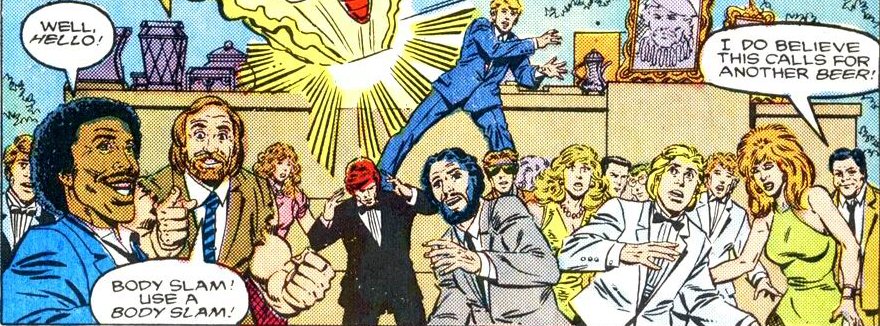
The above panels are from Iron Man v1 #227, part of the “Stark Wars” (more commonly known as “Armor Wars”) arc from the late 1980’s. Given recent events, I’ve had a hankering to read a story where Tony Stark takes the role of an anti-authoritarian jerk, and these stories have been effective at providing that fix. While it’s a bit overpraised, due to the warm and fuzzy aura of inflationary nostalgia, it remains a fun little read and quaint example of what passed for “badass” behavior in mainstream superhero comics at the time.

It also has those lovely celebrity cameos…. Let’s see, in the top panel we’ve got Lionel Richie (and thank you, Marvel Comics for getting that damn song stuck in my head), a brown-haired (?) Hulk Hogan, and George “Norm” Wendt from Cheers. I’m not sure if the big-haired woman next to Wendt is supposed to be Tina Turner after a coloring mistake or Motley Crue frontman Vince Neill in a dress. Either scenario is possible, I suppose.

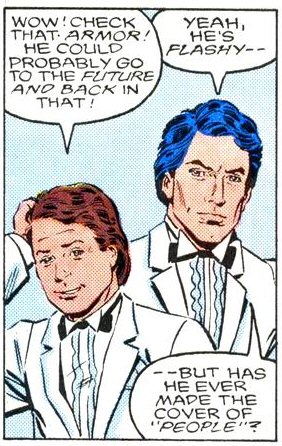
In the middle panel, we have Don Johnson, looking very much like a porn star (what, no pastel blue suit?), and a young starlet named “Brie” (God bless the 1980’s!) whose career was given a boost by Stark’s Hollywood connections in a previous issue. No, it’s not what it sounds like – Tony was already engaged in the CCA-approved suggestive bedding of a high-class yuppie caricature named – are you ready for it? – Rae LaCoste. (Not that Brie didn’t try for the brass ring, though. A mullet like Stark’s is hard for the ladyfolk to resist.)

Finally, in the bottom panel we have Michael J. Fox, making one of the worst, self-promoting popcult jokes in comedic history. Other lines considered and rejected for that word balloon included:

“That villain ought to see a doctor – Doc Hollywood!”
“He’s getting his ass handed to him like a casualty of war!”
“Iron Man is really High School USA-ing his ass!”
“Ma-ah-ah-ah-lll…” (That's a reference to Family Ties, not Fox's struggle with Parkinson's Disease. I do have some standards, after all.)

I’m not sure who the other guy in the panel with Fox is supposed to be. If it’s Pierce Brosnan, he must have left his polished exterior in his other suit that morning.

I get what writer David Michelinie and artist Mark Bright were trying to do in this sequence. They were attempting to show the sorts of folks that run in playboy billionaire Tony Stark’s orbit, even if the end result resembled something lifted from an old issue of Cracked magazine.

The whole cult of celebrity eludes me, though. One of my wife’s guilty pleasures is reading the various gossip rags while dining on food from one of the many take-out eateries we frequent. Occasionally, I’ll flip though one of her scandal sheets if I’m bored or waiting for her to get ready in the morning, but the bitchy tone and vicarious obsession with the career trajectories of the stupidly rich and untalented leaves me cold.

However, the concept of celebrity, and its distortive effects on people, fascinates me to no end. Forget the feather, heart, and balances of ancient Egyptian myth; if you want to know the true measure of what lurks in someone’s soul, just give them a few million dollars, some face time, and a personal assistant. The truth will come out every time.

Reel Big Fish – She’s Famous Now (from Why Do They Rock So Hard? 1998) – “She’s like me/just not as ugly.” I don’t know why I love that line, but I do.

Roxy Music – Virginia Plain (from Roxy Music, 1972) – From the deceptively soft opening, to the lack of a chorus, to the astonishingly abrupt end, this is a song calculated to screw with the listener’s expectations. I love it so very much.

Leftfield and Lydon – Open Up (from Leftism, 1995) – I wish John Lydon had done more, either with a refurbished Public Image Limited line up or as solo/collaborative project, to follow up on this exceptional track, which felt like the next logical step in his musical evolution. Instead we got the mercenary efforts of a Mountain Dew commercial and a fairly embarrassing Sex Pistols reunion, while The Prodigy’s Keith Flint did his best Lydon impersonation on 1996’s “Firestarter.” I’m sure the money was grand, John, but was it really worth it?

Friday, February 16, 2007

you can have me for an hour

Between catching up with four days of work and the hellish ninety-minute (usually accomplished inside twenty) commute home, I just don’t have the energy or desire to put together today’s originally planned post.

I guess we’ll just have to settle for a couple of tracks by Satisfact, one of a handful of mid-90’s American bands (along with the Pulsars and Servotron) who tried their hand at 80’s revivalism and were rewarded with the resounding apathy of the record buying public. (If they had debuted a decade later, it might have been a different story.)

Satisfact’s sound is a mélange of 80’s alt-rock influences, worn perhaps a bit too proudly on the band’s collective sleeve. Listening to the band’s first album, the presciently-titled The Unwanted Sounds of Satisfact, one can clearly pick out clear traces and snatches “borrowed” from the Cure, the Smiths, OMD, Bauhaus, and Joy Division. (In a bit of hubris that just begs for divine retribution, the album’s cover shamelessly mimics that of Joy Division’s Unknown Pleasures LP.)

It’s certainly listenable and, for less dogmatic fans of the source material, fairly enjoyable stuff, but it too often feels as if one is listening to an 80’s alt-gloom cover band that got it in their heads to record an album of “original” material. Allmusic.com gave it a glowing review, but it also used the word “doon” while doing so and thus cannot be trusted.

From The Unwanted Sounds of Satisfact (1996):

Satisfact – Dysfunction

Satisfact - Oscillator