
 Well, wish in one hand and crap in the other and see which one piles up first. - Mike Nelson
I wish I knew what was up with Super Lumina's right front tire.
I wish there was a presidential candidate I could vote for without feeling like I've compromised my principles.
I wish I could take a month off of work to catch up on the massive backlog of books, movies, videogames, and household projects that has built up over the past couple years.
I wish the Pepi the feral cat would let me get close enough to see if there is something wrong with his (or her; most likely "her") teeth.
I wish I could find a decent Wordpress template that fits Armagideon Time's needs without requiring massive modification.
I wish I knew what box my Psychotronic film guides got packed up into.
I wish I was immortal and indestructable.
I wish my gut could properly process whole milk.
I wish the health insurance people would send me the last piece of paperwork I need to file my taxes.
I wish I could find Marmalade, the orange twenty-pound feral cat, a good home.
I wish that comeuppance would come to those in need of it.
I wish I had the time to get a haircut, so I wouldn't have to see a rough facsimile of the Wild Angels-era Peter Fonda every time I looked in the mirror.
I wish my wishes were as witty and creative as the ones in this excellent track...
King Missile - I Wish (from The Way to Salvation, 1991)
Friday, February 15, 2008
all is not lost, not yet

Thursday, February 14, 2008
something in the air
The wise Saint Burt of Bacharach once said "what the world needs now is love, sweet love," citing a noticible global shortfall in that wonderful (and occasionally painful) state of bliss.
There has been a trend among the cynically hip set to denounce this day's holiday observances as nothing more than an market-driven grab for consumer's cash, but that bit of sour grapes masquerading as "getting wise" fails to consider that there are plenty of people out there who celebrate the meaning of the day without expending large sums of money. It's a perfect opportunity to reflect on things romantic, things that perhaps might have been back-burnered by the hectic schedule of everyday life. (It shouldn't happen, but it does.)
It doesn't need to involve a couple dozen long-stemmed roses or an overpriced shiny bauble. A handmade card made of construction paper and paste (proving again that the skillset I acquired in pre-school is of more daily use than my degree in English Literature) and a spontaneous hug can be just as, if not more, meaningful.
Still, if you want to know if he (or she) loves you so, it's in the kiss....
(from Crisis on Infinite Earths #1; by Marv Wolfman & George Perez)

(from Skeleton Key: The Celestial Calendar; by Andi Watson)

(from Manhunter (2004 series) #18; by Marc Andreyko, Javier Pina, & Fernando Blanco)

(from American Flagg! #2; by Howard Chaykin)

(from Mystery in Space #80; by Gardner Fox, Carmine Infantino, & Murphy Anderson)

(from Green Lantern #199; by Steve Englehart, Joe Staton, & Bruce Patterson)

(from the Queen Maura & Bitterandrew 2004 Wedding Special)
Have a happy Valentine's Day, folks.
The Troggs - Love Is All Around (from The Singles A's & B's, 2005) - The one true version. Accept no substitutes.
Circle Jerks - Put a Little Love in Your Heart (from Wild in the Streets, 1982) - A worthy entry in the well-established category of ironic punk covers of decidedly non-punk songs.
Lene Lovich - I Think We're Alone Now (Japanese Version) (from the reissue of the 1978 Stateless LP) - Did I post this before? I can't remember and I'm too lazy to check. It doesn't matter, because we could all use a bit more Lene Lovich in our lives, too.
Wednesday, February 13, 2008
the object of my desire
But, as communication in general tends to break down more and more, the existence of love becomes increasingly precarious. It is threatened on every side. Everything tends to reduce lovers to objects - Raoul Vaneigem, The Revolution of Everyday Life
A panel from a 1971 issue of Date With Debbi:
A sample letter from the advice column in a 1971 issue of Date With Debbi:
An excerpt from a feature on actress Maureen McCormick from a 1971 issue of Date With Debbi: (The article also states that the then fifteen year old McCormick was 4'8" and weighed sixty-eight pounds "dripping wet".)
An advertisement from a 1971 issue of Date With Debbi:
Kraftwerk - Sex Object (English Version) (from Electric Café, 1986) - Cold, clinical, and precise.
Raquel Welch - I'm Ready to Groove (from the OST to A Swingin' Summer , 1965) - But are you?
Tuesday, February 12, 2008
I find it kind of sad
Those among you who follow the comics internet must have heard that Steve Gerber, legendary comics writer and the creator of Howard the Duck passed away last Sunday at the age of 60. Instead of rehashing what other internet comics commentators have covered (and will cover) with more detail and eloquence (Mike Sterling has a nice rundown of the man's contributions), I figured I'd pay my respects by spotlighting a story of his that made a strong impression on a young Andrew and illustrates Gerber's particular talents.
The Guardians of the Galaxy were Marvel's answer to rival DC's Legion of Super-Heroes in the futuristic super-team stakes. Where the LSH's 30th Century setting was a populuxe sci-fi paradise, though, the Guardians' version of the future was considerably bleaker, with Earth and the rest of the solar system enslaved by the alien Brotherhood of the Badoon. The Guardians were a team of freedom fighters composed of sole survivors of various Badoon-ravaged worlds and led by Major Vance Astro, an 20th Century astronaut who had been sealed into a protective bodysuit and sent on a milllennia-long sublight trip to Alpha Centauri...only to find out that FTL travel had been discovered centuries before he arrived. (He did acquire some telekinetic powers during the trip, though that's a small consolation prize for a thousand years needlessly spent in solitude.)
The team debuted at the tail end of the Silver Age (in 1969's Marvel Super-Heroes #18), but the property remained fallow for half a decade until Gerber plucked them out of semi-obscurity to appear in his Marvel Two-In-One and The Defenders runs, which led to the team taking over the lead slot of Marvel Presents from Bloodstone, the immortal caveman monster hunter (why I love comics -- right there in five words), with issue #3 and continuing through the title's cancellation with issue #12. Gerber handled the writing duties up through issue #9, and what a short strange trip it was, replete with cosmic sex, giant space frogs, the family dynamics of male-female gestalt beings.
Which brings us to "Planet of the Absurd!" from Marvel Presents #5 (June 1976), written by Gerber with art by Al Milgrom and Howard Chaykin (more of the former than the latter is evident, unfortunately). I picked up my copy (along with the rest of the series) sometime in the early 80's from a quarter bin at one of the local flea markets, and it has stuck with me to the present day.
After freeing Earth from the Badoon (by calling the aliens' womenfolk and asking them to retrieve their wayward males), the members of the Guardians come to realize that they are tempermentally incompatible with the post-war status quo and decide to look for trouble adventure amongst the stars. An encounter with a unstoppable energy-devouring being severly damages their spaceship, and the need for replacement parts forces the team to beam down onto a nearby hellworld...a nightmarish place which bears a startling resemblance to mid-1970's Manhattan...
(It would take another couple of dec-phases before the megalomaniacal R'Dee G'ewlee'anee would impose order with his spiked iron fists.)
The team decides it would be more efficient if they split up in their search for the equipment they need, which provides an opportunity for each member to come face to face with some of the bizarre aspects that make up this strange yet familiar world.
Native Centauri tribesman Yondu stumbles across a curious ritual featuring a symbiotic dance between the false promises of the ringleaders and the jaded apathy of the spectators...


Major Astro, on the other hand, get offered a chance at unspecified fuzzy consciousness-raising...

After a fracas with the local constabulary, Jovian militiaman Charlie-27 learns that the quality of mercy on this world is not strain’d, but droppeth as the gentle plea bargain from the district attorney's office, depending on mandatory sentencing laws and prison overcrowding...

Meanwhile, Mercury native Nikki discovers the wonders of spirituality...

Having pissed off every faction on the planet, the Guardians find themselves besieged by an angry mob. Surrounded and cut off, their prepare to make their final stand...only to find themselves rescued by the perfectly timed arrival of a strange shuttlecraft. The ship's pilot explains that the world the Guardians has stumbled upon is actually a mental asylum set aside for the sector's "most hopelessly neurotic specimens." That's all well and good, but Astro, who had previously wondered about the planet's Star Trek-esque parallels to 20th century Earth, is still wondering about one thing...

ur homeworld is teh crazee, d00d.
"Planet of the Absurd" is not especially inspired as comic stories go, and certainly nowhere near Steve Gerber's best work. The satire is wielded like a blunt instrument and the twist ending telegraphed with a tight-channel lossless signal, yet it manages to typify what I consider the essence of Marvel's non-flagship output in the 1970's -- that combination of lurid weirdness, social awareness, and tongue-in-cheek humor that Gerber was a unparalled master in delivering.
The society seems to have accepted the notion that by simply becoming oblivious to what's happening in the world outside our skins, the horror will go away. It's not going to go away. - Steve Gerber, from a 1978 Comics Journal interview
Yeah, he knew the score.
Tears For Fears - Mad World (from The Hurting, 1983) - Such a promising start, where did it all go wrong? (My answer: With the release of "Everybody Wants to Rule the World".) For some unexplained reason, everytime I hear this song I expect it to turn into The Who's "Behind Blue Eyes" halfway through.
Monday, February 11, 2008
go tell Chief Brody

Actor Roy Scheider has passed away at the age of 75.
He was of that rare breed of "regular guy" working actors (see also James Caan) that helped make 70's cinema the wonderfully unique beast that it was. Over the course of his film career, Scheider tangled with Marseillais drug smugglers, two killer sharks, a fugitive Nazi dentist, an alien monolith, and the introduction of hack sci-fi elements and the DeLuise brothers into the seaQuest DSV universe -- only to succumb to complications related to his recent struggle with myeloma.
It's a damn shame, really. You'd think that having survived a Jeannot Szwarc film and the machinations of Universal (by itself and with its tag team partner, NBC) executives, cancer of the blood plasma would have been small potatoes.
Adios, Roy. As the wife put it, "The Mayor of Shark City is dead? Summer is over."
Roy Scheider & Ben Vereen - Bye Bye Love (from the All That Jazz OST, 1979) - The coda to Bob Fosse's 1979 semi-autobiographical musical, which netted Scheider (in the role Fosse's fictionalized avatar) an Oscar for Best Actor. Using the song that launched the Everly Brothers as a springboard, the piece weaves together the complementary strains of self-indulgent excess associated with both the musical genre and the Me Decade. Clocking in at just under ten bombastic minutes, the track falls well outside the boundaries of casual listening material, but it serves as an excellent reminder (if you lived through the era) or perfect illustration (if you came of age afterward) of what set the 1970's apart from any decade before or since.
Arthur B. Rubinstein - Main Title/Crook Dusting (from the Blue Thunder OST, 1983) - I'd make a witty comment about how the paranoia-laden militarization of law enforcement theme of this 1983 Scheider/assault helicopter buddy flick seems oddly prescient, given the path American society has taken in the past quarter-century, but I'm too busy massaging my temples and trying to get my jaws to unclench.
Sunday, February 10, 2008
1-2-3 happy neighborhood
Sunday is a day of rest...and at Armagideon Time, it's also a day of lazy music video posts.
I wonder if I could pull off having a haircut like Jim Bob's at my age... I'm very tempted to try even if my bangs don't curl.
Saturday, February 09, 2008
too many damn elms

Sigh.
I linked to this article by Pal Ken a couple days ago. If you didn't read it then, take a couple of minutes to do so now.
Don't worry, I'll still be here when you're done.
Finished? Good. I thought Ken did an exceptional job in analyzing fandom's more extreme tendencies, especially the irrational sense of entitlement frequently exhibited by the vocal minority of self-identified "fans." He didn't resort to the facile "GET A LIFE, NERDS" dismissal, but instead maintained a reasonable, jocular tone throughout the piece (which my own experience has shown to be the best way to approach such subjects).
Of course, fandom -- especially internet fandom -- being what it is, this was one of the responses he got to his article. (I'd advise against reading the comments, but you're all grown-ups so do what you will..) The writer accuses Ken of being a body fascist (because of the miguided cosplay -- a redundant term as far as I'm concerned, regardless of the cosplayer's body type -- photo chosen to illustrate the article), a hypocritical snob, and a bigot.
All three are standard shafts in the quiver of fandom's response to bruised egos, but what really stood out when I read the response is that the author seemed instrinsically unable to discern that there are differences between:
- appreciative and obsessive levels of fan behavior
- "shunning" and not getting neck deep in an unwinnable argument with a zealot
- being a passive consumer of product (or "cattle") and having a sense of perspective over a work's actual relevance in the grand scheme of things, and choosing one's battles accordingly
There's also the question of what the measure of a work's "success" or "failure" actually is. By irrational fandom's standards, far too frequently the scales are calibrated to "how close it hews to my own (internal or external) fanfiction," the consequences of which reach fractal levels of subjectivity, resulting in a cacophony of aggrieved voices amplified by way of the internet.
Here's the rub, though: it is entirely possible for a work to simultaneously succeed at its purpose and defy the beholder's expectations. Roddy Doyle's "Barrytown" novels, for example, are chock full of elements that pull the rug out from under the reader's feet, and that's what makes them so damn compelling. The Committments could have made it big or The Van could have ended on a cheerier note, but Doyle chose to do what any creator with self-respect would do -- he followed his own muse, for better or for worse. (In this case, for better.) If input is going to be made, I'd rather defer to a skilled editor or trusted peer than to the shrill messageboard axe-grinding of someone calling themselves "CraZeeGael313."
The idea that the creative process should be dictated by a self-appointed soviet of fans is absurd, as is the stock retort of "I pay your salary." No, unless you own the publishing firm or studio, you actually pay (directly or indirectly) a small portion of the revenue that flows back into the firm. That's one "vote" or a small percentage of votes (if one has mobilized a group of similarly-minded crusaders) weighed in the capitalist arena against those of the vast majority of readers/viewers who don't feel the need to rant about the heresies committed against their own personal visions of fan perfection.
Does that seem unfair? I suppose it may, but I'm not one who automatically associates "loudness" with "righteousness." Nor have I coupled my sense of self-worth to the vagaries of disposable genre entertainment, for that matter.
The Who - Had Enough (from Who Are You, 1978) - Amen.
Friday, February 08, 2008
Friday Night Fights: And It Hurts So Bad
In which we tune in to find space-mercenary Erin O'Rourke-Singh (a.k.a. "Dart") and her lover/partner, Blackjak, at that uncomfortable "Who do you love more -- me or the embodiment of cosmic evil who spared your life in order to use you as a weapon against my friends and family?" stage of their relationship. (Hey, it happens more often that you'd think.) Let's see how it works out for those kooky kids...


Such a shame, really.
"It's a fantastic series, but it's burdened with folks' perception of it being a licensed 'toy' comic." So said the owner of the comic shop I used to frequent in my junior high school days, and he was correct. While Atari Force's fusion of space opera and superheroics does show its age in places, the twenty-issue follow-up to the pack-in comics that came bundled with various 2600 Atari games still makes for an entertaining read even after twenty-odd years, especially compared to DC's other sci-fi offerings from the period. (Conqueror of Barren Earth or Sun Devils, anyone? No, me neither.)
I'd credit the lion's share of this durability to García-López's exceptional art (he was replaced by the not quite as excellent Eduardo Baretto with issue #13), though writer Gerry Conway (replaced by Mike Baron with issue #14) also did some damn fine work, above and beyond what was on display in his Firestorm and JLA runs at the time.
The series has spawned many good memories and a cult following in fandom circles, and frequently crops up on wishlists of series deserving of a trade paperback release. The question of whether or not one will ever materialize is complicated by the whole licensing issue (and the fact that the interest of a couple dozen folks on the internet isn't a reliable indicator of potential sales), At the time of the comic's original publication, DC and Atari were both subsidiaries of Warner Brothers. Since then the Atari brand and logo have been acquired by Infogrames, which adopted the iconic name as its own. I'm not going to hold my breath waiting for a potential soliciation of a collected edition, though it would be swell to finally see the series printed with proper color correction on better quality paper.
Soft Cell - Where Did Our Love Go? (from Non-Stop Erotic Cabaret, 1982) - Ball and Almond's other attempt at reinterpreting sixties soul as sleazy synthpop failed to make the same impact on the listening public's consciousness as their cover of "Tainted Love" did, though this track was a worthy -- and quite enjoyable -- effort.
(Viva Bahlactus!)
Thursday, February 07, 2008
knew this was a big mistake
Today, we're going to take a musically annotated trip through some of the more interesting ads found within the pages of 1985's Legion of Substitute Heroes Special #1. The comic is a farcical romp starring the 30th Century's most famous also-rans. Most of the humor is more "funny huh" than "funny ha-ha," and presumes that the reader is familiar with LSH minutae, but it does feature some fine art by Keith Giffen (working his unmatched José Muñoz-cribbing mojo).
It's not the type of thing I'd suggest as recommended reading, as those of you who are interested in that sort of thing most likely already read it and those of you who aren't couldn't give two shits about an in-joke-heavy superhero humor comic published twenty-three years ago. Besides, it's not the actual content that we're going to take a look at today, but some lovely enticements for iffy goods and services.
First up is the 1985 Triple Crown winner of the Consumer Fraud, Violation of Animal Protection Statutes, and Personal Liability Lawsuit stakes... Nothing brings the funny like placing a irritable venomous reptile on your algebra teacher's chair. It's all in good fun, right?
"Freightening," indeed.
Duran Duran - Union of the Snake (from Seven and the Ragged Tiger, 1983) - The end of the line as far as my interest in the band goes, with heavily qualified exception made for "View to a Kill" solely due to its unremitting cheesiness.
I bought my copy of SATRT at a used record store in the winter of 1992. The previous owner had pressed some maple leaves between the inner and outer sleeves. A sweet gesture, but by the time I had come into possession of the LP, the leaves had been pulverized into a fine dust that managed to insinuate itself into every nook and cranny of my bedroom when I went to play the record.
Hvng trbl wth yr nglsh? Mb ths dmn vwls r t blm. Lt ths flks hlp u. I cn hz a fwnks lssn? N thy sy cmix rdrs r ltrt....
The Noble Knights - Sing a Simple Song (from the What It Is! Funky Soul And Rare Grooves:1967-1977 box set, 2006) - Sly Stone wrote it, King Curtis produced it, you need to listen to it.
You may have hear of needle exchanges, the controversial but forward-thinking programs designed to minimize health risks associated with intravenous drug use. That's all well and good if you're a heroin addict, but what about the poor souls who have been stuck with a backlog of terrible puns, knock-knock jokes, and stale one liners? What options do they have? "I'll trade you a drag-and-drop ethnic joke for two gags about mothers-in-law." "Throw in a coarse scatalogical pun and we have a deal."
I've found that it's easier to get my jokes from the uncut, pink, sugary source.
The Beau Brummels - Laugh, Laugh (from Introducing the Beau Brummels, 1965) - From the San Francisco folk-rock act's pre-giant-waterfowl period.
Our final featured ad asks a very important question:
I guess my answer would be:
"An interesting footnote in Japanese history that has been romaticized and mythologized by westerner boy-men with leanings toward ex oriente lux attitudes and fetishes for martial arts weapons. Due to media hyper-saturation, whatever aura of coolness ninjas possessed has long-since evaporated, leaving behind just another irritating hipster/fanboy cliché."
The London Funk Allstars - How to Be a Ninja in One Easy Lesson (from Flesh Eating Disco Zombies Vs the Bionic Hookers from Mars, 1996) - Finally, a trip hop album made specifically with Chris Sims in mind.
So concludes today's journey though the comic ads of yesteryear. So, Noseless Pulsar Stargrave, having seen what goods and services were being pitched to comics readers in the mid-eighties, how do you feel about comics fans now?
That's a little harsh, though I can totally see where you're coming from.
Wednesday, February 06, 2008
a tale of a tree

In the woods across the street from my childhood home stood an enormous dead tree. It must have been quite the sight when it was alive, and it still managed to dominate the westward view from my backyard even in death, resembling a giant's skeletal hand reaching up though the sumac and scrub.
The inexorable tag-team of entropy and the elements eventually stripped the hand of its gnarled, twisted fingers, leaving just the amputated spike of the trunk standing on the high bank by a bend in the brook. On a spring afternoon in 1982, having nothing better to do, my friend Artie and I decided that we would bring the rest of the tree crashing down.
It was one of those examples of impromptu self-amusement that comes naturally to children and is envied by adults. Equipped with an arsenal of busted, rusted, or broken tools scavenged from the junkyard or "liberated" from unlocked sheds, we proceeded to chip away at the rotted base of the trunk.
It wasn't an easy task; even adjusting for kid's-eye-view inflation, the trunk had to have been about five to six feet in circumference and around twelve feet in height. The outside layer of wood was thoroughly soft and rotten; it had the texture of damp foam rubber and infested with all manner of grubs and small black beetles (who likely were irritated by the two snot-noses encroaching on their turf). Underneath the mush, however, was a solid hardwood core that shook off all but our most determined efforts. We were in no hurry, though, and toiled away a couple of hours a day over the next few weeks.
Eventually we reached a point where the trunk could be shifted by a series of enthusaistic kicks delivered through Sears' brand boys' workboots. A creak-groan of snapping cellulose, a cry of "TIMBER", and the tree came crashing down, the top of the trunk clearing the brook to flatten the bushes on the opposite bank. (It would have made a nice bridge if the undergrowth on the other side hadn't been impassable. It did provide a nice place to sit and dangle one's feet over the water, providing one didn't mind the occasional beetle bite on one's hindquarters.)
It was wicked cool to witness, but once the giddy high-fives and repeated utterances of "Did you see that?" were done with, we felt a bit lost. We had achieved our goal, but had invested ourselves so intently in making it happen that we never considered what we'd do afterwards.
We didn't try to do something more productive, like pick up litter or start a petition to make the woods into a city park. We just wanted to knock down more trees.
On the way home from our Sunday shopping trips, I occasionally take a detour through the old neighborhood, inflicting my stock set of nostalgic rambles upon my poor wife. The woods across from my old house are gone, gobbled up by suburban sprawl's insatiable appetite for open space and replaced with a subdivision. All traces of Artie's and my childhood handiwork have been excised from the landscape.
There's a message in there, I think.
Metro Stylee - Destroy (from Metro Stylee, 1998) - I posted the Girls Gone Ska version of this track back in September '06. This is the slightly different version which appeared on the N.Y. band's debut (and, as far as I know, only) album and it's a catchy little number dealing with karmic retribution, negationism, and pacifism.
Paul van Dyk feat. St. Etienne - Tell Me Why (The Riddle) (Radio Edit) (from a 2000 single) - Why? Because I said so. And because I think this track is rather nice.
Tuesday, February 05, 2008
a horse and contract rider approaches

From BitterAndrew's Comprehensive Guide to Films That Don't Exist, But Should:
Equestrophobic southern sherriff Bill Gillespie (Steiger) is forced to team up with Ed (Harvester), a visiting police horse from the big city, in order to solve a mysterious murder in this unusual blending of low comedy and socially aware drama.
Though the film unwisely goes a tail-lifting joke (of five) too far, both leads turn in exceptional performances. Steiger adds an astonishing degree of depth to his character, which a lesser talent might have simply portrayed as a broad redneck caricature. Gillespie's attempts to come to grips with the fact that Ed will only speak in his presence reflect a greater internal transformation where the scales of anti-equine bigotry fall away to reveal genuine feelings of respect and friendship toward his four-legged partner.
As good as Steiger's performance was, Harvester's was even better, being able to convey a wealth of nuanced emotion though such simple gestures as the stomp of a hoof or the flick of a tail. His comedic timing, too, was absolutely flawless (although I'm still perplexed over what appeared to be a length of nylon fishing line dangling from his mouth during the scenes where he speaks).
Harvester would ultimately win the Academy Award for Best Actor for his role in the film, but chose to boycott the award ceremony, instead sending playwright Peter Shaffer to deliver a speech about the unfair portrayals of Equine-Americans in the mass media.
Three stars.
Jay Livingston - The Theme from Mr. Ed (from Television's Greatest Hits, Vol. 1: From the 50's and 60's, 1990) - There was a time when "domestic fantasy" sitcoms were considered to be the bottom of the televisual barrel, and the most frequently cited example of the mediums will toward banality. This was, of course, before Dance War and Celebrity Rehab hit the small screen and made My Mother, The Car look like high fucking art in comparion. Watching the bitter residue of Jeff Conaway get ointment rubbed on his lower back or watching Jerry Van Dyke get poked in the ass (complete with cartoon sound effect) by a spring directed by a sentient automobile -- I know what I'd choose.
Echo & The Bunnymen - Bring on the Dancing Horses (from the Pretty in Pink OST, 1986) - Albums That Meant Something, Mini-Version: Back in the early months of Maura's and my relationship, we and my ever-present punk rock pal used to head over to Maura's house after classes to hang out in her den and engage in some basic cable channelsurfing -- poking fun at the Club MTV audience, getting a whiff of uncured nostalgia from USA's Cartoon Express, and so forth.
Shortly before the end of the Spring 1992 semester, the three of us sat through a TBS showing of Pretty in Pink, and we had a blast enjoying the retro vibe while bitching about the film's pro-yuppification message.
The next day was one of Maura's work days, which meant that it was up to my friend and me to entertain ourselves, which usually meant walking up Mass Ave from Central to Harvard, checking out the used vinyl stores along the way, and grabbing some Cafe Aventura pizza at the end of the trip. This time, though, my friend had unspecified "plans" to attend to and left me to fly solo.
I did, though in a more purpose-driven fashion than usual, figuring that I'd pick up a used copy of the Pretty in Pink soundtrack (the songs and good memories were still fresh in my head) then try and meet Maura at Alewife Station, as it was where I caught the bus back to Woburn anyway and a stone's throw from the hotel where she was working at the time. Imagine my surprise when I stepped onto the Alewife concorse and discovered my punk rock pal already waiting there.
It was nothing compared to his surprise as his stammered out some excuses about medical appointments and hoping to run into me and so forth. As much as I hate rushing to judge, something about his language and mannerisms stunk worse than Alewife Brook's shopping carriage-filled waters in late August. After a few minutes of stilted conversation, Maura arrived, though circumstances prevented me from directly asking her if she had any knowledge about what the hell was going on.
It turned out that she didn't, and it wouldn't be revealed to her until the following Sunday evening. That was when my so-called pal, high on John Hughes's brand of sentimental melodrama and unrealistic expecations, showed up on Maura's parents' doorstep to profess his love for her (and be shot down in the brutally blunt manner for which my other half is reknowned for).
So, yeah. "Bring on the Dancing Horses" is a lovely bit of alternapop, and perhaps the finest track Mr. Echo and Friends ever recorded. It also induces an almost inperceptable reflexive grimace whenever I listen to it. This is why I've strenuously lobbied to have all teen romantic comedies labeled with a "MCABIDF" warning -- "May Cause Absurd Behavior In Deluded Fools."
(One final note: If you happen to live in a Super Tuesday state and are disgusted as much as I am by the slate of candidates, "Bamboo Harvest" would make a perfect choice for a spite-in -- I mean "write in" -- candidate. The poor palamino has been dead for thirty-eight years, but I still have more confidence in his leadership skills than in any of the current roster of clowns.)
Monday, February 04, 2008
many a tear has to fall

I was walking home from the 7-11 in Woburn Center when the Patriots won Superbowl XXXVI, I couldn't bring myself to watch the game; memories of 1986 and 1997 were still fresh in my mind. After Adam Vinatieri sealed the Pats' win with a field goal in the last seconds of the final quarter, a massive triumphant roar rose from the row of houses along Main Street. It was the sound of bucking the odds and accomplishing the impossible, louder than an oncoming Red Line train even from my sidewalk vantage point.
It's a good memory, and why I can't fault Giants fans for savoring that same feeling after last night, especially when their team gave it their all...while the Pats, well, I have no fucking clue what the Pats were thinking on the field yesterday. It seemed as if there was some kind of mass amnesia affecting the team, causing them to somehow forget the second half of the season -- where the rest of the NFL copped on to the Pats formula for lopsided wins, thus leading to a late-season war of adaptive tactics -- and place their faith in historic destiny. Destiny, sadly, is a poor substitute for an intelligent offensive strategy, even more so when faced with an exceptionally determined defense.
So the Patriots had a (multiple) record-breaking season, and the Giants pulled off an epic upset victory. Such are the vagaries of sport, and apart from some minor aches stemming from bruised regional pride, it ultimately means very little in the grand scheme of things where my life is concerned. I've still got a pile of work in my inbox, I've still got to decide between two eminently unpalatable choices in tomorrow's Democratic presidential primary, and the CD player in Super Lumina is still broken.
(Boston area FM radio is utter crap, by the way. The "oldies" station, traditionally a safe bet, has taken to playing Billy Joel songs in recent years. My Zune car adapter can't arrive soon enough.)
Granted, I'd probably feel differently if I had money riding on the outcome (an aversion to gambling is the only bit of vestigal Protestantism that has stuck with me over the years) or was one of those curious sorts whose sense of self-worth is enmeshed with the fortunes of the local team (Pal Ken has an interesting piece on that phenomenon up on his site today).
Or, you know, if it had been the Red Sox losing to a New York team. My graciousness does have its limits.
Tommy Edwards - It's All in the Game (from The Complete Hits of Tommy Edwards, 1995) - One of the songs you will NOT hear on the the local oldies station, as it has dropped its catalogue of 50's music from its programming list in favor of disco and easy listening material from the 1970's and early 1980's. (Billy Fucking Joel, for Sheol's sake. "Old" does not equal "oldies," people.)
A side note: The melody of "It's All in the Game" was composed in 1911 by future vice-president Charles Dawes. The instrumental version, titled "Melody in A Major," made the swing orchestra rounds before lyrics were added to the piece in the early 1950's. Thus was an oft-covered pop standard born.
Sunday, February 03, 2008
don't need to be a groundhog to know which way the wind blows
I popped my head of out my carefully-constructed bunker yesterday to try and forecast what's in store for us in the time that's coming. I saw nothing but shadows, long, dark, and ominous. All the roads lead to a single destination...
We have now crossed over into the Armagideon Time Zone...
Time Zone - World Destruction (from a 1984 single) - As Afrika Bambaataa and John Lydon have prophecied, so shall it come to pass. At least, that's what those who are in power or who are aspiring to claim that power this November are hell bent in making manifest. Despite the differences in packaging, it's all the same product...and it carries the bitter taste of ashes.
Saturday, February 02, 2008
the game he plays, he plays for keeps
Take one of the oldest gags in the comedic lexicon, add Samuel L. Jackson, and I think the result would go something like this:
A little advice, Percy -- don't skimp on the gratuity.
(Yeah, I'm passing up on making any number of Sam Jackson jokes/references regarding this comic strip because I'm feeling lazy today. Feel free to make your own.)
Curtis Mayfield - Superfly (from The Very Best of Curtis Mayfield, 2000) - So damn perfect, in so many ways.
Friday, February 01, 2008
Friday Night Fights: I've Kissed Mermaids
As I was putting together yesterday's musical tribute to fallen minor comic characters, two thoughts occurred to me:
1. I'd have bought a monthly Aquagirl comic drawn by George Perez without hesitation.
2. For a character that was essentially a sidekick of a sidekick (and a halfhearted attempt to expand one of DC's less successful superhero franchises) who only appeared (mostly in minor roles) in a couple dozen stories during the eighteen years between her introduction and her death, Aquagirl (a.k.a. Tula) had the best-developed personality of all the Aquaman Family of characters. Granted, the most introverted sea slug would have seemed positively gregarious in comparison to Aquaman's befuddled surliness and Aqualad's agressive blandness, but even outside that shallow grading curve, Tula was pretty remarkable.
She was a "gawky pig-tailed kid" who matured into a strong-willed young woman who was unafraid to cut loose and enjoy herself...
...regardless of what the more staid men in her life thought about such behavior.
It wasn't just a case of being a flighty party girl, either, but was rooted in a sense of self-confidence... ...expressed (not frequently enough, sadly) by a willingness to dive in fist-first...
 ...and do whatever it took to get the job done.
Not that those qualities helped Tula much when she was caught in a spray of Chemo's toxic puke, but that's comics for you. One minute you're doing the sea-frug in Dr. Dorsal's Deep Sea Discoteque or throttling evil henchmen, and the next you're sucking up a lungful of caustic liquids sprayed into the Upper New York Bay of a parallel earth.
For the musical portion of our program, I need a song that incorporates oceanic imagery as well as the theme of tragic death. Something melancholy, yet oddly playful...
I've got it:
Pixies - Wave of Mutilation (from Doolittle, 1989) - There are only two songs by the Pixies I can bring myself to listen to. This is one. Feel free to try and guess what the other one is.
Thursday, January 31, 2008
nothing will ever be the same again


And Psycho, I miss you more than all the others
and I salute you, brother.
Those are c-listers who died, died
They were all poor saps, and they died.
The preceding was brought to you by Crisis on Infinite Earths and this song...
The Jim Carroll Band - People Who Died (from Catholic Boy, 1980) - One of the two "list" songs that became alternative format and college radio staples back in the good old days (at least on the Boston airwaves), the other song being The Nails' "88 Lines About 44 Women." Apparently the interplay between eros and thanatos extends even to quasi-novelty songs.
Wednesday, January 30, 2008
Albums That Meant Something - Part 3 - Tell the World About It
During the early to mid-1980's, my mom worked in the speaker assembly plant for H.H. Scott, one the of pioneering manufacturers of stereo components (long since absorbed into the Emerson brand). I'm sure I still have one of the company's promo t-shirts, emblazoned with the very classy tagline "SCOTT PUTS OUT" (front) "HIGH FIDELITY COMPONENTS" (back)" in a storage crate up in the attic somewhere.
One of the perks that came with the job was access to deep discounted audio gear, stuff that had either been discontinued, used as demo models, or experienced some minor cosmetic wear, and it wasn't long before everyone in our circle of family and friends were kitted out with H.H. Scott sound systems. Mine was the first big-ticket purchase I ever made in my thirteen years of life, and included a receiver, cassette deck, and two 40-watt speakers. I was too cheap to spring for a turntable at the time, which was foolish, but vinyl was already being seen as a dead, excessively care-intensive format. It was paid for via an installment plan, with cost (somewhere in the vicinity of a hundred bucks) deducted from my weekly allowance over a couple months.
The design of the components (which I still have a few packed away in storage) might appear quaint and retro by today's standards, what with the metallic faceplates, overuse of LED displays, and excessively tiny buttons (an over-reaction to the 70's standard outsized switches and knobs, I'd guess), but at the time I felt like I was on the cutting edge of home audio. (Well, apart from the lack of a CD player, but that technology was still in the early-adopter luxury phase.)
The act of sacrificing a significant portion of my weekly comics and videogame budget to acquire the system proved to be a decisive moment in terms of my listening habits. Previous to that, I had been a mostly passive music fan, mostly influenced by Top 40 radio (or video, technically, as programmed on V-66, a local UHF channel dedicated to music videos) and the inescapable hard rock/"ugly" metal fandom of my teenage peers. The music was just there, it wasn't anything I actively sought out, apart from the occasional must-have single or poorly-dubbed cassette copy of a "hot" LP made by a friend. (It's why I laugh about whines regarding the failings of digital formats; the sincerity of devotion inspired in my crowd by a muddy-sounding taped copy of Back in Black, complete with incidental household noise in the background, outstrips any of the professed, overly formalist appreciation by the audiosnob set.)
The problem was that I had pretty much outgrown my love of Ratt and Twisted Sister by my thirteenth summer, and as for the Top 40 charts...
...well, the less said, the better. (I did own a copy of Dire Straits' Brothers in Arms, though.) Now before anyone starts bringing up the quite wonderful "alternative" rock scene happening at the time, I'd like to point out that it's penetration into my little corner of blue collar suburbia was virtually nil. It was possible to catch the videos for "Let's Go to Bed" or "How Soon Is Now" on V-66 (Maura, three years older and hipper than I, has an old VHS tape with the station's airing of The Damned's "Is It A Dream" on it), they had a hard time registering on the conscious when one is living in an environment where the musical spectrum ran the gamut from classic rock to pop metal.
Plus, there was the fact that my purchasing power was relatively small at the time. Buying a new release meant hazarding the bulk of my allowance on an untried quantity more than likely to consist of 80% filler to 20% killer. The bargain and cutout bins, stuffed to the gills with cheapjack compilations and greatest hits albums plaster with "Super Saver" or "Nice Price" labels made for safer bets with better returns. I initially dived in with no genre leanings to speak of, picking up remaindered K-Tel comps (Chartaction '83! Featuring Adam Ant, Frieda, and After the Fire!), sell-through classic rock albums (Zep, Steppenwolf, Cream), and retro-oriented soundtracks.
It was a purchase in the latter category that marked the other half of my transfomation into an active audiophile, specifically The Blues Brothers soundtrack, which offered an outstanding selection of covers and rerecordings of classic soul and R&B cuts. As I've stated in a previous post, even if the Ackroyd/Belushi tracks are pale imitations of the original songs, the album nonetheless offers an unparalled roadmap for the uninitiated to discover the real deal. Even though I rarely listen to the album these days, it's influence in shaping my musical tastes was immense and continues to this day.
Yet, for all that, The Blues Brothers soundtrack isn't this week's "Album That Mattered." That honor goes to an album that would be my first purchase directly inspired by the 1980 film, in which it appeared onscreen and two songs from it were heard, but not represented on the OST. It also turned out to be a major fucking hassle to find a copy of it in the local music stores; though once I did score one, it would end up being the definitive BGM for the lion's share of my teenage years. That album is The Best of Sam & Dave, a slightly abridged compilation of the legendary soul duo's singles and b-sides released in early 1969. (The CD reissue includes the omitted tracks plus a few more.)
The 8-track cassette of the album is shown playing in the Bluesmobile's stereo during the sequence in the film featuring the fateful traffic stop and lead-up to the extravagantly destructive mall chase scene, providing enough time for substantial portions of both "Hold On, I'm Comin'" and "Soothe Me" to be heard in the background.
Including a nod to Sam & Dave in the film was a no-brainer, as they, more than any of the other artists paid homage to, were the direct inspiration for Jake & Elwood Blues -- a pair of male soul vocalists with different yet complementary styles and a penchant for high-energy stage performances. (Both outfits were also backed by a roster of Stax Records' house musicians, including members of Booker T & The MG's.) The seamless interplay between Sam Moore's intense "southern soul" vocal stylings with Dave Prater's more Motown-esque delivery is simply glorious to hear, whether in a velvet-smooth and dreamy slow jam or in a thumping, backbeat-and-horn-driven uptempo number, and the pair performed both styles equally well (which wasn't uncommon among 60's soul artists, actually).
While I did eventually pick up the remainder of Sam & Dave's 1960's discography (as well as complete compilations of 60's Stax/Atlantic soul and R&B singles) in the months and years following, it's The Best of Sam & Dave I always seem to return to whenever I feel the urge to hear some exceptionally sweet soul music (though in terms of individual tracks, nothing will ever surpass Eddie Floyd's "Knock on Wood). Unlike most things from my junior high school days, it has remained immune to the crippling associations of adolescent stupidity that force me to avert my gaze when I look back on that period of my life.
And, honestly, there's no higher praise I could bestow.
Sam & Dave - You Don't Know What You Mean to Me - Seriously, how can you not love this stuff? Dig that opening, too, which showcases the duo's gospel influences.
This was my original song choice for the anniversary tribute post, but I reconsidered after I realized that Maura in all likelihood does know what she means to me. At least, I hope she does.
Tuesday, January 29, 2008
an elegance of mind and a brace of pistols
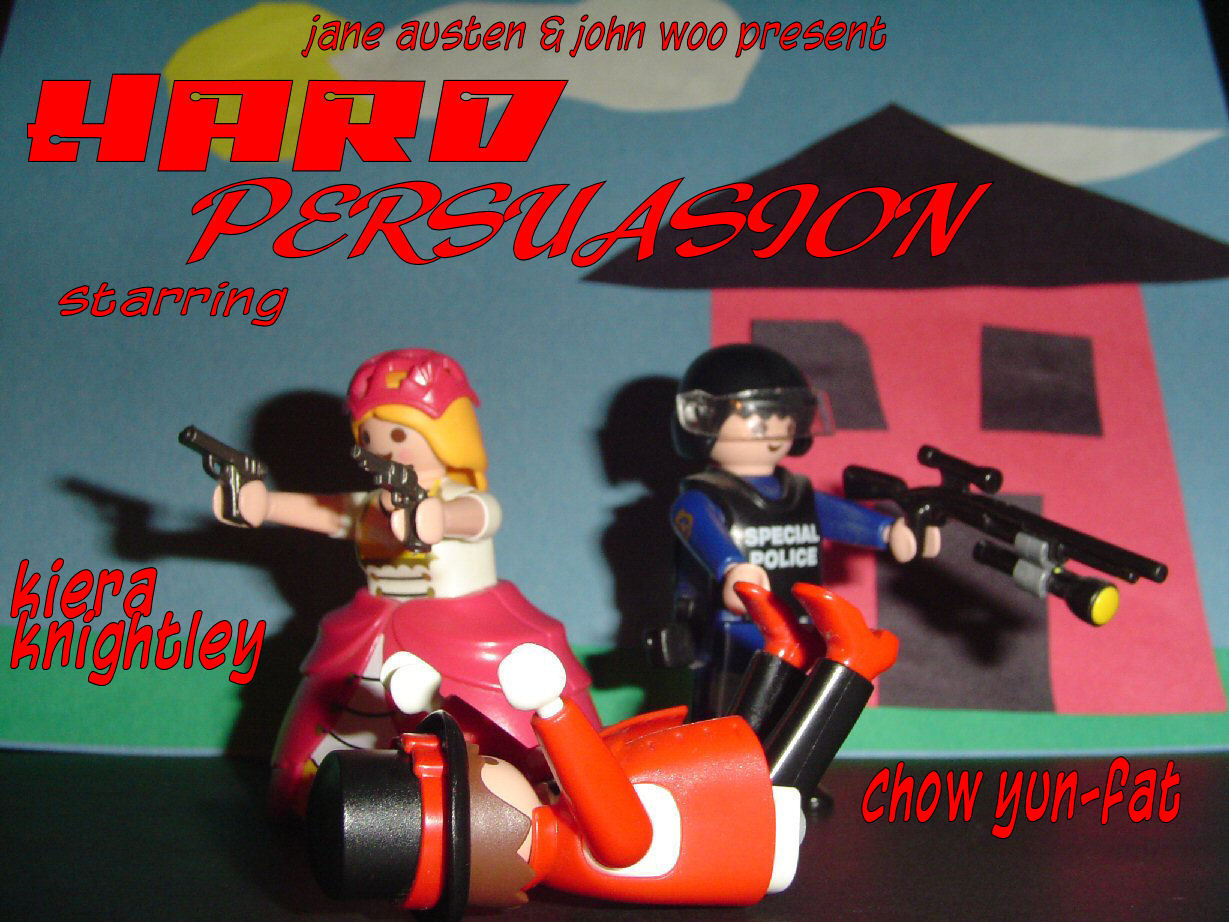
From BitterAndrew's Comprehensive Guide to Films That Don't Exist, But Should:
A nineteen year old Anne Elliot (Knightley) is pressured by her family to break off her engagement with a police inspector nicknamed "Tequila" (Chow). She believes it to be a simple matter of class differences, but eight years later, the truth comes out when she again crosses paths with her former love, only this time he's returned to take down a vicious smuggling ring led by Anne's megalomaniacal father (Ralph Fiennes) and the sinister Lady Russell (Emma Thompson).
The film offers an uneven, but watchable, combination of Regency period opulence, tragic romance, and a record-high body count. The climactic shootout (filmed inside Bath's Royal Crescent) is a masterpiece of balletic violence and stylistic excess. Two stars.
Hugo Montenegro - MacArthur Park (from Moog Power, 1969) - When the apocalypse comes -- and I say "when" not "if" -- only the rats and roaches will survive, and they'll be humming the equally unkillable "MacArthur Park" in the aftermath. "Someone left a cake out in the hard rain."
Prodigy - Firestarter (Instrumental) (from the WipeOut XL OST, 1996) - Music to launch quake disruptors to while screaming through the tunnels of Odessa Keys.
Monday, January 28, 2008
that is I think I disagree

I was up until the wee hours of Saturday evening (or, more accurately, Sunday morning) dealing with my upteenth irritating head cold of the season. (A wiser man might be concerned about such a recurrence of illness, but I've never prided myself on matters of wisdom.) Having resigned myself to feverish and phlegmy wakefulness, I decided to finish rereading the final chapters of The Gun Seller, Hugh Laurie's quite entertaining novelistic mash-up of P.G. Wodehouse and Len Deighton, but ended up watching a late night showing of How I Won The War on one of the cable movie channels.
I've watched the film, a 1967 black comedy with an anti-war slant, at least half a dozen times over the years, but I'm still uncertain how I feel about the film. Directed by Richard Lester, it bridges the stylistic gap between the 1965 Beatle vehicle Help! and the surreal 1970 post-nuclear satire, The Bed-Sitting Room, in terms of Lester's appropriation of absurdist elements (which, I'd argue, reached an unintentional apotheosis in the Lester-helmed Superman II.)
How I Won the War follows the misadventures of the hopelessly inept Lt. Goodbody (played by Michael Crawford, who I'll forever associate with this, and especially this), who manages to stumble unharmed through the Second World War, though at the cost of the lives of those under his command. The events are presented as absurdist farce, making ample use of physical comedy, slapstick, documentary footage, and even elements of pantomime -- all wrapped up in a very 1960's, very self-conscious "avant-garde" veneer -- to bring its message home.
Despite all its creative ambitions and good intentions, however, the film never manages to equal the sum of its (frequently inspired) parts, and ends up falling into that oh-so-infuriating category of "interesting mess." Absurdity and war are hardly strange bedfellows, but what sets something like How I Won the War and better realized works like Pynchon's Gravity's Rainbow or Heller's Catch-22 (the twin pillars of the literary subgenre) is that the absurdity in those novels is presented as a natural consequence of the bureaucratization of mass slaughter, in which irrationality has assumed its own merciless and horrifying logic. (Mike Nichols's flawed cinematic version of Heller's novel managed to grasp the concept, though it frequently stumbled in conveying it onscreen.) How I Won the War, on the other hand, too often treats the absurdity as a matter of aesthetic window-dressing, which has the effect of undercutting the intended anti-war message and reducing it to facile sloganeering or wit for wit's sake. Imagine Samuel Beckett and Eugene Ionesco cranking out a WW2 version of Candide for some quick booze and cigarette money at the behest of MoveOn.org, and you'd have general idea. An IMBD.com commenter described the film as a "sheep in wolf's clothing," and despite the well-documented caveats regarding information gleaned from that source, it's a very apt description.
The movie isn't devoid of effective moments or elements, it's that they are swamped amidst the gimmicky cinematic clutter. The replacement of fallen members of Goodbody's outfit with silent, single-colored ghosts who continue to serve in death I found to be an effectively macabre touch, suggesting the utter inescapability of the mad situation. There is one scene in particular which I found to be extremely haunting: Goodbody, taken prisoner by the Germans, is sitting on a rail embankment as he awaits interrogation. He looks behind him at a closed boxcar stopped on the tracks, and the fingers of an emaciated hand poke out through a gap in the door as Goodbody is led away by his captors. It's a very simple, yet brutally effective moment which draws attention to an aspect of the war (mass-graves, gas chambers, crematoriums) ignored in the countless boiler-plate cinematic depictions of the war up to that time. It's a shame that the film as a whole couldn't sustain that level of insightfulness.
These days, How I Won the War is mostly remembered for featuring John Lennon (in his only non-Beatles-related cinematic appearance) as Musketeer Gripweed, Goodbody's batman (small "b," but we can dream) and a petty thief who "never found anything worth stealing." It's a smallish supporting role, though you'd never know that by looking at the VHS box. A little bait-and-switch never hurt anyone, right?
It was during the filming of How I Won the War that Lennon began composing what would become one of the greatest (if not the greatest) pop songs ever recorded, an oblique tribute to his childhood in Liverpool. There's no excuse for not having your own copy of the original (unless who happen to hate The Beatles, which is more of an explanation than excuse), so I'm posting an interesting, if inferior, cover version instead.
I'm referring to, of course:
Plastic Penny - Strawberry Fields Forever (from Two Sides of a Penny, 1968) - Known primarily for their one hit, 1968's "Everything I Am," the various members of this psych rock/proto-prog outfit later moved on to work with Elton John, UFO, and Procol Harum. Actually, this track sounds pretty close to what I imagine a Procol Harum cover of "Strawberry Fields Forever" would have sounded like.
Sunday, January 27, 2008
make no mistake
I'm taking a break today, for reasons I may or may not discuss tomorrow.
Here's something to tide you over until then:


 Posts
Posts

