Thursday, January 31, 2008

nothing will ever be the same again

The Prince caught it in the back down on Bourbon Street.

Don was a pacifist, now he's cold meat.

Tula choked on a lungful of toxic waste.

Kid Psycho was squashed into a fine paste.

And Psycho, I miss you more than all the others
and I salute you, brother.

Those are c-listers who died, died
They were all poor saps, and they died.

The preceding was brought to you by Crisis on Infinite Earths and this song...

The Jim Carroll Band - People Who Died (from Catholic Boy, 1980) - One of the two "list" songs that became alternative format and college radio staples back in the good old days (at least on the Boston airwaves), the other song being The Nails' "88 Lines About 44 Women." Apparently the interplay between eros and thanatos extends even to quasi-novelty songs.

Wednesday, January 30, 2008

Albums That Meant Something - Part 3 - Tell the World About It

During the early to mid-1980's, my mom worked in the speaker assembly plant for H.H. Scott, one the of pioneering manufacturers of stereo components (long since absorbed into the Emerson brand). I'm sure I still have one of the company's promo t-shirts, emblazoned with the very classy tagline "SCOTT PUTS OUT" (front) "HIGH FIDELITY COMPONENTS" (back)" in a storage crate up in the attic somewhere.

One of the perks that came with the job was access to deep discounted audio gear, stuff that had either been discontinued, used as demo models, or experienced some minor cosmetic wear, and it wasn't long before everyone in our circle of family and friends were kitted out with H.H. Scott sound systems. Mine was the first big-ticket purchase I ever made in my thirteen years of life, and included a receiver, cassette deck, and two 40-watt speakers. I was too cheap to spring for a turntable at the time, which was foolish, but vinyl was already being seen as a dead, excessively care-intensive format. It was paid for via an installment plan, with cost (somewhere in the vicinity of a hundred bucks) deducted from my weekly allowance over a couple months.

The design of the components (which I still have a few packed away in storage) might appear quaint and retro by today's standards, what with the metallic faceplates, overuse of LED displays, and excessively tiny buttons (an over-reaction to the 70's standard outsized switches and knobs, I'd guess), but at the time I felt like I was on the cutting edge of home audio. (Well, apart from the lack of a CD player, but that technology was still in the early-adopter luxury phase.)

The act of sacrificing a significant portion of my weekly comics and videogame budget to acquire the system proved to be a decisive moment in terms of my listening habits. Previous to that, I had been a mostly passive music fan, mostly influenced by Top 40 radio (or video, technically, as programmed on V-66, a local UHF channel dedicated to music videos) and the inescapable hard rock/"ugly" metal fandom of my teenage peers. The music was just there, it wasn't anything I actively sought out, apart from the occasional must-have single or poorly-dubbed cassette copy of a "hot" LP made by a friend. (It's why I laugh about whines regarding the failings of digital formats; the sincerity of devotion inspired in my crowd by a muddy-sounding taped copy of Back in Black, complete with incidental household noise in the background, outstrips any of the professed, overly formalist appreciation by the audiosnob set.)

The problem was that I had pretty much outgrown my love of Ratt and Twisted Sister by my thirteenth summer, and as for the Top 40 charts...


...well, the less said, the better. (I did own a copy of Dire Straits' Brothers in Arms, though.) Now before anyone starts bringing up the quite wonderful "alternative" rock scene happening at the time, I'd like to point out that it's penetration into my little corner of blue collar suburbia was virtually nil. It was possible to catch the videos for "Let's Go to Bed" or "How Soon Is Now" on V-66 (Maura, three years older and hipper than I, has an old VHS tape with the station's airing of The Damned's "Is It A Dream" on it), they had a hard time registering on the conscious when one is living in an environment where the musical spectrum ran the gamut from classic rock to pop metal.

Plus, there was the fact that my purchasing power was relatively small at the time. Buying a new release meant hazarding the bulk of my allowance on an untried quantity more than likely to consist of 80% filler to 20% killer. The bargain and cutout bins, stuffed to the gills with cheapjack compilations and greatest hits albums plaster with "Super Saver" or "Nice Price" labels made for safer bets with better returns. I initially dived in with no genre leanings to speak of, picking up remaindered K-Tel comps (Chartaction '83! Featuring Adam Ant, Frieda, and After the Fire!), sell-through classic rock albums (Zep, Steppenwolf, Cream), and retro-oriented soundtracks.

It was a purchase in the latter category that marked the other half of my transfomation into an active audiophile, specifically The Blues Brothers soundtrack, which offered an outstanding selection of covers and rerecordings of classic soul and R&B cuts. As I've stated in a previous post, even if the Ackroyd/Belushi tracks are pale imitations of the original songs, the album nonetheless offers an unparalled roadmap for the uninitiated to discover the real deal. Even though I rarely listen to the album these days, it's influence in shaping my musical tastes was immense and continues to this day.

Yet, for all that, The Blues Brothers soundtrack isn't this week's "Album That Mattered." That honor goes to an album that would be my first purchase directly inspired by the 1980 film, in which it appeared onscreen and two songs from it were heard, but not represented on the OST. It also turned out to be a major fucking hassle to find a copy of it in the local music stores; though once I did score one, it would end up being the definitive BGM for the lion's share of my teenage years. That album is The Best of Sam & Dave, a slightly abridged compilation of the legendary soul duo's singles and b-sides released in early 1969. (The CD reissue includes the omitted tracks plus a few more.)

The 8-track cassette of the album is shown playing in the Bluesmobile's stereo during the sequence in the film featuring the fateful traffic stop and lead-up to the extravagantly destructive mall chase scene, providing enough time for substantial portions of both "Hold On, I'm Comin'" and "Soothe Me" to be heard in the background.

Including a nod to Sam & Dave in the film was a no-brainer, as they, more than any of the other artists paid homage to, were the direct inspiration for Jake & Elwood Blues -- a pair of male soul vocalists with different yet complementary styles and a penchant for high-energy stage performances. (Both outfits were also backed by a roster of Stax Records' house musicians, including members of Booker T & The MG's.) The seamless interplay between Sam Moore's intense "southern soul" vocal stylings with Dave Prater's more Motown-esque delivery is simply glorious to hear, whether in a velvet-smooth and dreamy slow jam or in a thumping, backbeat-and-horn-driven uptempo number, and the pair performed both styles equally well (which wasn't uncommon among 60's soul artists, actually).

While I did eventually pick up the remainder of Sam & Dave's 1960's discography (as well as complete compilations of 60's Stax/Atlantic soul and R&B singles) in the months and years following, it's The Best of Sam & Dave I always seem to return to whenever I feel the urge to hear some exceptionally sweet soul music (though in terms of individual tracks, nothing will ever surpass Eddie Floyd's "Knock on Wood). Unlike most things from my junior high school days, it has remained immune to the crippling associations of adolescent stupidity that force me to avert my gaze when I look back on that period of my life.

And, honestly, there's no higher praise I could bestow.

Sam & Dave - You Don't Know What You Mean to Me - Seriously, how can you not love this stuff? Dig that opening, too, which showcases the duo's gospel influences.

This was my original song choice for the anniversary tribute post, but I reconsidered after I realized that Maura in all likelihood does know what she means to me. At least, I hope she does.

Tuesday, January 29, 2008

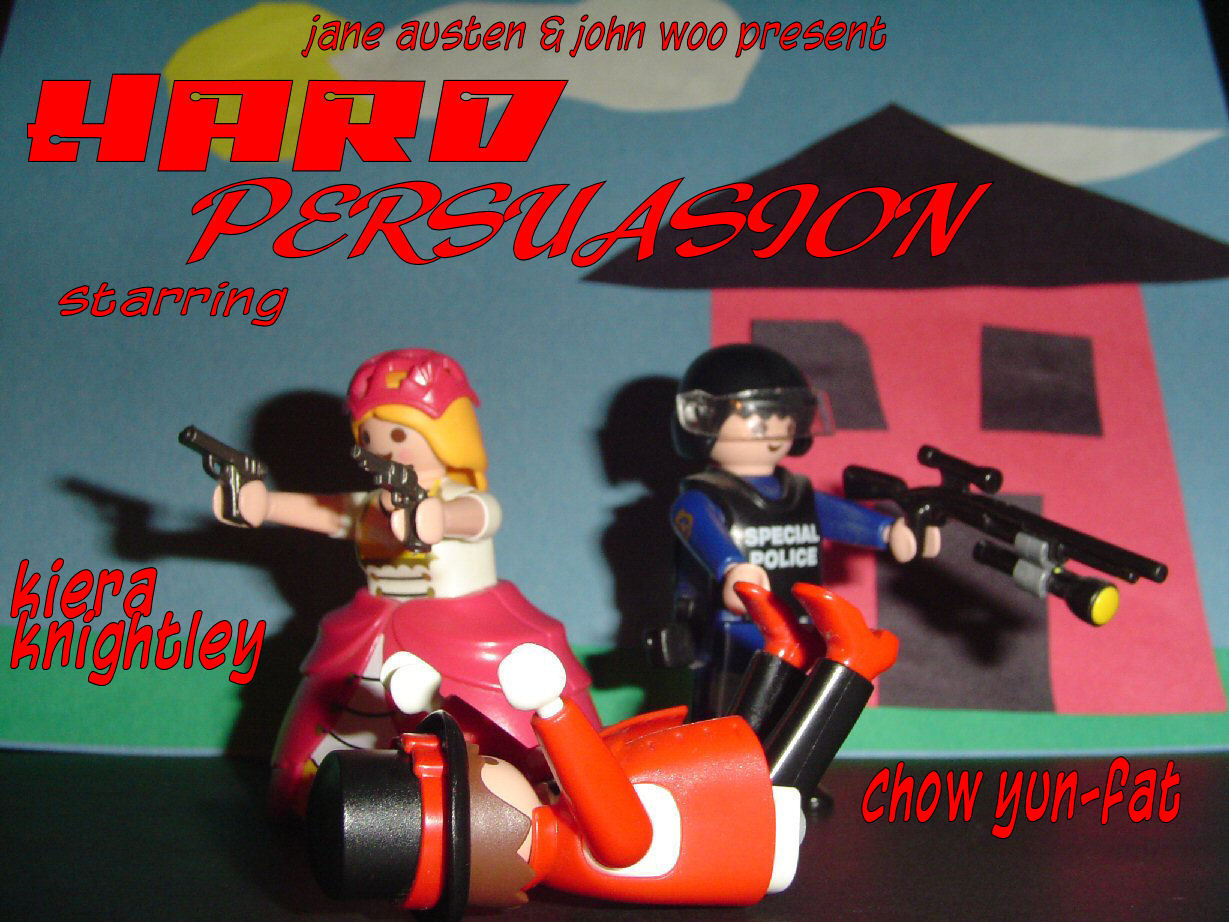
an elegance of mind and a brace of pistols

When I yielded, I thought it was to duty; but no duty could be called in aid here, only the satisfying symphony of small arms fire.

From BitterAndrew's Comprehensive Guide to Films That Don't Exist, But Should:

A nineteen year old Anne Elliot (Knightley) is pressured by her family to break off her engagement with a police inspector nicknamed "Tequila" (Chow). She believes it to be a simple matter of class differences, but eight years later, the truth comes out when she again crosses paths with her former love, only this time he's returned to take down a vicious smuggling ring led by Anne's megalomaniacal father (Ralph Fiennes) and the sinister Lady Russell (Emma Thompson).

The film offers an uneven, but watchable, combination of Regency period opulence, tragic romance, and a record-high body count. The climactic shootout (filmed inside Bath's Royal Crescent) is a masterpiece of balletic violence and stylistic excess. Two stars.

Hugo Montenegro - MacArthur Park (from Moog Power, 1969) - When the apocalypse comes -- and I say "when" not "if" -- only the rats and roaches will survive, and they'll be humming the equally unkillable "MacArthur Park" in the aftermath. "Someone left a cake out in the hard rain."

Prodigy - Firestarter (Instrumental) (from the WipeOut XL OST, 1996) - Music to launch quake disruptors to while screaming through the tunnels of Odessa Keys.

Monday, January 28, 2008

that is I think I disagree


I was up until the wee hours of Saturday evening (or, more accurately, Sunday morning) dealing with my upteenth irritating head cold of the season. (A wiser man might be concerned about such a recurrence of illness, but I've never prided myself on matters of wisdom.) Having resigned myself to feverish and phlegmy wakefulness, I decided to finish rereading the final chapters of The Gun Seller, Hugh Laurie's quite entertaining novelistic mash-up of P.G. Wodehouse and Len Deighton, but ended up watching a late night showing of How I Won The War on one of the cable movie channels.

I've watched the film, a 1967 black comedy with an anti-war slant, at least half a dozen times over the years, but I'm still uncertain how I feel about the film. Directed by Richard Lester, it bridges the stylistic gap between the 1965 Beatle vehicle Help! and the surreal 1970 post-nuclear satire, The Bed-Sitting Room, in terms of Lester's appropriation of absurdist elements (which, I'd argue, reached an unintentional apotheosis in the Lester-helmed Superman II.)

How I Won the War follows the misadventures of the hopelessly inept Lt. Goodbody (played by Michael Crawford, who I'll forever associate with this, and especially this), who manages to stumble unharmed through the Second World War, though at the cost of the lives of those under his command. The events are presented as absurdist farce, making ample use of physical comedy, slapstick, documentary footage, and even elements of pantomime -- all wrapped up in a very 1960's, very self-conscious "avant-garde" veneer -- to bring its message home.

Despite all its creative ambitions and good intentions, however, the film never manages to equal the sum of its (frequently inspired) parts, and ends up falling into that oh-so-infuriating category of "interesting mess." Absurdity and war are hardly strange bedfellows, but what sets something like How I Won the War and better realized works like Pynchon's Gravity's Rainbow or Heller's Catch-22 (the twin pillars of the literary subgenre) is that the absurdity in those novels is presented as a natural consequence of the bureaucratization of mass slaughter, in which irrationality has assumed its own merciless and horrifying logic. (Mike Nichols's flawed cinematic version of Heller's novel managed to grasp the concept, though it frequently stumbled in conveying it onscreen.) How I Won the War, on the other hand, too often treats the absurdity as a matter of aesthetic window-dressing, which has the effect of undercutting the intended anti-war message and reducing it to facile sloganeering or wit for wit's sake. Imagine Samuel Beckett and Eugene Ionesco cranking out a WW2 version of Candide for some quick booze and cigarette money at the behest of MoveOn.org, and you'd have general idea. An IMBD.com commenter described the film as a "sheep in wolf's clothing," and despite the well-documented caveats regarding information gleaned from that source, it's a very apt description.

The movie isn't devoid of effective moments or elements, it's that they are swamped amidst the gimmicky cinematic clutter. The replacement of fallen members of Goodbody's outfit with silent, single-colored ghosts who continue to serve in death I found to be an effectively macabre touch, suggesting the utter inescapability of the mad situation. There is one scene in particular which I found to be extremely haunting: Goodbody, taken prisoner by the Germans, is sitting on a rail embankment as he awaits interrogation. He looks behind him at a closed boxcar stopped on the tracks, and the fingers of an emaciated hand poke out through a gap in the door as Goodbody is led away by his captors. It's a very simple, yet brutally effective moment which draws attention to an aspect of the war (mass-graves, gas chambers, crematoriums) ignored in the countless boiler-plate cinematic depictions of the war up to that time. It's a shame that the film as a whole couldn't sustain that level of insightfulness.

These days, How I Won the War is mostly remembered for featuring John Lennon (in his only non-Beatles-related cinematic appearance) as Musketeer Gripweed, Goodbody's batman (small "b," but we can dream) and a petty thief who "never found anything worth stealing." It's a smallish supporting role, though you'd never know that by looking at the VHS box. A little bait-and-switch never hurt anyone, right?

It was during the filming of How I Won the War that Lennon began composing what would become one of the greatest (if not the greatest) pop songs ever recorded, an oblique tribute to his childhood in Liverpool. There's no excuse for not having your own copy of the original (unless who happen to hate The Beatles, which is more of an explanation than excuse), so I'm posting an interesting, if inferior, cover version instead.

I'm referring to, of course:

Plastic Penny - Strawberry Fields Forever (from Two Sides of a Penny, 1968) - Known primarily for their one hit, 1968's "Everything I Am," the various members of this psych rock/proto-prog outfit later moved on to work with Elton John, UFO, and Procol Harum. Actually, this track sounds pretty close to what I imagine a Procol Harum cover of "Strawberry Fields Forever" would have sounded like.

Sunday, January 27, 2008

make no mistake

I'm taking a break today, for reasons I may or may not discuss tomorrow.

Here's something to tide you over until then:

Saturday, January 26, 2008

historical inevitability versus laser beams

Until a mid-90's change in postal regulations, comic book publishers were forced to include a couple of text pages in each individual comic in order to qualify for the second class bulk rate for periodicals. Before the letters page/editorial page format became the standard method of fulfilling this requirement, publishers often filled two pages with dubious "educational" content or generally terrible short stories.

Fawcett's Captain Marvel Adventures, a series which I've professed my love for in more than a few previous posts, met its obligations to the USPS though an ongoing series of stories starring "Lieutenant Jon Jarl of the Space Patrol" written by "Eando Binder," actually a collaborative pseudonym of brothers Earl and Otto Binder ("E and O"), though some sources credit Otto (who was also writing the Captain Marvel comic stories at the time) with pulling the lion's share of the weight. The two already had an impressive sci-fi writing résumé under their belts -- including the highly influential "I, Robot"/Adam Link material published in Amazing Stories in the late 1930's and early 1940's -- but none of that previous magic was on display with the Jon Jarl stories, which were stock "two-fisted" sci-fi adventure tales flatter than the paper they were printed on. Given the stories' principal purpose, they didn't have to aspire to anything more artistically, though such awareness doesn't make them any more readable.

As a result, whenever I flip through an issue of CMA, I tend to skip past the Jon Jarl pages in favor of actual comics content featuring the Big Red Cheese battle rogue sausage-making machines or atomic killer robots. However the title, and accompanying racist caricature, which adorned this installment of Lt. Jarl's adventures from Captain Marvel Adventures #142 (March 1953)...

...piqued my curiosity enough that I had to find out what the full story was.

Fawcett, though its roster of titles featuring the various Marvel Family members, backed Truman's police action against Global Communism on the Korean Peninsula 110%. The lead story in CMA #142 in fact featured Captain Marvel going up against the (again) grotesque racist caricature of the "Red Crusher" and his insidious Bolshevik "lightning machine." Apparently not content in limiting the patriotic agitprop and demonization of the other to the comic content, Binder felt compelled to expand his platform to include the text pages, as well.

The following is an abridged yet annotated retelling of "Korea of Space":

The story begins with Jon Jarl, the 22nd century's answer to Joe Friday, stuck working the Asteroid Beat, a boring place where the biggest crimes are hotlinking images and failure to give due credit for borrowed content (wait, I'm thinking of another Beat). Things get interesting, however, when Jarl finds a largely intact satellite embedded into the side of a stray asteroid. He determines the object is of mid-twentieth century origin, more specifically from the year 1953 (a blatant bit of plothammering of an example of post-war technoptimism? Take your pick).

Upon exploring the vessel's interior Jarl discovers that the crew is intact, but flash-frozen into a state of suspended animation. Using his belt's Atomic Heat Lamp (concerns about radiation damage to reproductive organs in the 22nd century have been mitigated by the ubiquity of Vend-o-Baby machines), Jarl thaws out the timelost travellers...

...only to discover that they are a lost detachment of North Korean soldiers whose weapons platform had been knocked off course by a comet. They are naturally curious about the outcome of the war, and Jarl takes an unusual amount of pleasure in telling them of their eventual loss (if by "loss" you mean a shaky cease-fire stretching over five decades along a demilitarized zone and complicated by nuclear weapons ambitions). The future-shocked Stalinists don't take the news well:

"Furthermore," added Jarl pulchritudinously, "Nyah, nyah, nyah!"

Next time anyone moans in your presence about how comics content used to be more innocent and kid-friendly back in the "good old days," feel free to point out the astonishingly frank level of racist content in this story, which if anything is more restrained than what appears in the actual comics material featured in this issue and others dealing with similar subject matter.

While sickened by the stench of centuries old Bolshevism, Jarl still condescends to offer assistance in helping the soldiers find a place in this brave new world...


(Vintage popcult ethnic shorthand lesson #26: "Buddha" = "Asian" "Oriental," even if the characters in question are atheistic Reds)

The duplicitous commies have other plans, however, and begin to embark on a Glorious People's Crusade throughout the belt colonies.

"...and if we should have to use our status as galactic superpower to force compliance from those backwards natives though political assassinations, election tampering, or other black op tactics, that's a price the United Worlds is prepared to pay. Our access to their markets, I mean the notion of liberal democracy, demands it," thought Jarl petuantly.

Call it "Space Man's Burden."

The archaic technology of the North Koreans is no match for the pocket nukes and high-yield lasers of Jarl's patrol craft, which he unleashes with a sense of estatic glee that makes one question the psych-screening procedures of the Space Patrol Force.

"It's a little something we in the 22nd century call the Bush Doctrine. It's how we brought modern civilization to the Venusians -- and those thirteen survivors out of an original population of fifty million are grateful to us for it," Jarl said pusillanimously.


The procrustean nature of the narrative, the lack of rudimentary plot logic, the uncomfortable feeling that you're reading a transcipt of someone's personal fantasy rather than a considered work of literature... Well, I'll be! I think we've just stumbled across the ur-text from which all fanfic was derived!

The entire time I was reading this story, I had the most powerful feelings of deja vu. I eventually figured out why. "Korea of Space" is remarkably similar in plot to the original Star Trek series episode "Space Seed," only heavier on the Red Scare agitprop and tragically devoid of an over-the-top fight scene featuring William Shatner and Ricardo Montalban. Which is a shame, because there are few works so terrible that they could not be redeeemed by the addition of James T. Kirk delivering his trademark two-handed, entwined-fingers, downward punch.

And it goes without saying, but also: YOOOOOONNNNNNNNNNGGGGGGGGGGG!

The Rezillos - Cold Wars (from Can't Stand the Rezillos, 1978) - Gleefully anachronistic, heavy on the sci-fi elements, and free of racist caricatures. It's a win-win-win situation! (Seriously, though, if you don't own a copy of this album, go out and buy one at the soonest available opportunity. You'll be glad you did.)

Friday, January 25, 2008

Friday Night Fights: Love Like Violence

Violence is to superhero comics what MSG is to cheap Chinese takeout. In fact, the genre is pretty much predicated on equal lashings of over-the-top beatdowns and melodramatic exposition. Yet for all the facekicks and collateral damage, superheroic violence operates under a different set of rules than the less entertaining genuine article, working on a level only a couple short steps above what one would encounter in a old Warner Brothers cartoon -- the permanently crippling injuries and sprays of gore that would realistically be associated with being hit with a swung lamppost or casually tossed automobile traditionally kept to a minimum (and that even applies to the ostensibly "darker" and "grimmer" tone of today's stories).

It's larger-than-life light entertainment, after all, and there's a significant number of people out there who get a kick out of seeing, say, Hercules and Wonder Man beating the stuffing out of each other in a relatively consequence-free environment. But while the superheroic genre can accommodate a wide variety of other genre tropes -- sci-fi, western, heroic fantasy, crime procedural, humor -- it does possess definite conventions that a writer should at least be aware of, even if their ultimate goal is to upend or subvert them.

Of these conventions, the one where many writers fumble with is the notion of "realism" (which, like the notion of "authenticity" in rock music, actually refers to verisimilitude.) It's not that superheroic material can't be delivered in a more true-to-life fashion (see Watchmen or even Astro City), it's that haphazardly dragging and dropping "realistic" elements into an otherwise genre-standard material puts excessive stress on the desired quality known as suspension of disbelief, kind of like featuring a brutally graphic murder in the middle of a light teen comedy without ever bothering to reflect the implications or shift in tone. If you're going to toss these things out, you have to be willing to follow them all the way to the ground.

Which brings me to Avengers v1 #213. After an unanticipated membership drive leaves the Earth's Mightiest Heroes short-handed, founding member Hank Pym (a.k.a Yellowjacket, Ant-Man, Giant Man, and Goliath) decides to rejoin the team, where his wife/superheroic partner/fellow founding member, Janet (Van Dyne) Pym (a.k.a. The Wasp), had already been serving in an active membership role. Dr. Pym had never been the most stable of personalities. Despite being one of the earliest characters in Marvel's roster of Silver Age superheroes, he never achieved the same level of popularity as Thor, Hulk, Spider-Man and the rest and experienced a series of rechristenings and reinventions which centered around an inferiority complex and a history of mental instability.

During his first outing with the new Avengers lineup, Pym (as Yellowjacket), tries too hard and screws up badly, almost causing a castastrophe. An understandably miffed Captain America, acting as team chairman, calls for court martial proceedings, which only feeds the unstable Pym's persecution complex. Wasp does her best to shake her husband out of his funk, but Pym's growing resentment spills over into his personal life and, like too many shitheads, decides take it out on the one person who sincerely wants to help him.

Pym has his own plan for redemption, namely a giant killer robot designed to crash the court martial procedings, and whose weak spot is known only to himself, thus giving him an opportunity to look cool in front of his accusers. The Wasp finds out about this plan and tries to dissuade her husband from this craziness, and gets a fist to the face for her efforts.

Grotty in the extreme, yes? Still, within the context of a genre where taking hits from spandex-clad psychopaths is commonplace, it's not too offsides...

...except that in this case, "realistic" consequences are applied. Even as broad melodrama, it's incredibly heartbreaking...but the consequences are constrained by the genre conventions:

Wasp reveals her black eye during the hearing. Pym summons the giant robot. Giant robot nearly kills Pym. Wasp takes down the giant robot. Pym slinks out of the hearing in shame. (Because when you've got an individual who is violent, unstable, and who has access to super-scientific gadgets and the Avengers' secrets, it's best just to let him wander off somewhere.)

The results are akin to those generated by the requisite "very special episode" of any given seventies or eighties sitcom. If you lived through the era, you know the drill: the stale gags are swapped out for a single episode dealing with rape, molestation, or drug abuse before reverting to the old status quo in the following week's installment. It's not the lack of continuity that makes such efforts problematic, but rather the cognitive dissonance in tone for the sake of ephemeral relevance.

Pym's storyline did continue for another eighteen months, but the primary focus was placed upon the further downfall and eventual "redemption" of Hank Pym as he gets caught up in the plot of old archenemy attempting to exploit Pym's misfortune. The Wasp's reaction to these life-changing events was muted in comparison, consisting mostly of her keeping a stiff upper lip while other characters wondered whether she was just putting up a strong front. She did win the role of Avengers' leader in issue #217, and even scored what perhaps writer Jim Shooter considered a bit of payback...

...but lensed as "comic book violence" which just feels shoddy and weak (not that any type of violence or tit-for-tat nonsense could have worked in the context of what had occurred previously).

Everyone handles things differently, especially in matters concerning relationships and love. I knew a woman who punished her cheating beau by forcing him to live with the "other woman." Hillary Clinton was able to work past Bill's philandering ways. I know that if I ever pulled anything like Hank Pym, though, I'd be lying in a hospital bed awaiting facial reconstruction surgery. Yet, still, in light of all that, Wasp's behavior in these stories feels "off" to me. Not in a sense of being out of character, but in lacking any sense of who the character is.

It reads as if having set up the situation for the sake of telling a story about Hank Pym, the writers (Jim Shooter, then Roger Stern) decided to back-burner the Wasp's side of the story, which ought to have assumed at least an equal degree of pathos. (To be fair, during his run on The Avengers, Stern did more to establish the Wasp as a three-dimensional character than any other Avengers writer before or since.) Even the issue spotlighting Wasp's brief rebound fling with Tony Stark (until she discovers he is actually Iron Man) was presented more in terms of its effect on Pym and as another catalyst for Stark's own impending downfall as a hero.

It reaches its creepiest, however Avengers #230, the conclusion of the storyline, when a "vindicated" Pym is lauded by the Avengers for his heroism and offered a place with the team again (an idea Pym himself thinks is incredibly stupid). The vindication in question is wholly predicated on his foiling the villain's frame-up scheme with his previous unstable and violent behavior (toward his ex-wife the other Avengers) marginalized and euphemized as a "breakdown," since recovered from and left as that.

Or, actually, as this...


Again, everyone deals in their own way, but the default setting for such encounters is probably closer to this, based on my own empirical observation of similar events....


The serial storytelling format being the voracious Ouroboros that it is, Hank Pym and the Wasp eventually got back together as a romantic couple, with the "abusive" aspect softened into a "tempestuous but destined" one, which I suppose would make them the Luke and Laura Spencer of the superhero set. All sins can be forgiven forgotten, if by doing so more grist is generated for the plot mill.

According to Wikipedia, the incredibly dysfunctional shrinking couple have parted ways yet again, with Pym currently shacking up with Tigra. Interesting, that, given the history...

Hey! This isn't another example of that "women prefer assholes over nice guys" bullshit, is it?

Ike & Tina Turner - You Should'a Treated Me Right (from Proud Mary: The Best of Ike & Tina, 1991) - What? Why are you giving me that look? It's a contextually appropriate and outstanding bit of old school R&B. That's all, honest.

(He is above all mortal concerns.)

ride the mild surf


I generally don't do reposts, but due to the sheer number of Google search hits and emailed requests, I've decided to make an exception. The fact that the song in question is a longstanding favorite of mine, and ranks right up with the Modern Lovers' "Roadrunner" in terms of my intimate familiarity with the cited geographic features also played a major factor in my decision.

So here it is:

The Gremies - No Surfing in Dorchester Bay (from a 1980 single) - The Gremies were a local supergroup of early Boston punk acts, featuring members from DMZ/The Lyres, Unnatural Axe, and the Real Kids. (The b-side of the 7" consists of a dub version of the track.)

I first became aware of this single after stumbling across an entry (with a photo of the picture sleeve) in the college library's copy of Who's New Wave in Music, and I made locating a copy of it the highest of acquistional priorities -- mainly because I have spent nearly every weekday since the autumn of 1990 toiling away on the shore of that frequently pungent body of water. The view from my cubicle window looks right out onto it, actually, and I can indeed confirm the bay's lack of surfability.

Thursday, January 24, 2008

you're just wasting my time

When I was in my middle teens, I had difficulties sleeping at night (for reasons I still don't quite comprehend). I eventually discovered that leaving the radio on when I went to bed made it easier to nod off, the background noise serving as an effective lullaby.

My initial choice of listening was the local classic rock station, as the comfortable familiarity of the playlist was tailor-made to doze off to. That changed after a fever-dream plagued night when I woke up to the rock-disco crossover nightmare known as David Bowie's "Fame," the one song capable of forcing me to reassess my otherwise high levels of respect for both The Thin White Duke and John Lennon. I eventually settled on WBZ's evening-through-morning lineup of call in talk radio programs, tuning in at night to Larry Glick and waking up to Dave Maynard.

The overall tone of these shows was light and more than a little corny -- a open community chat format peppered with novelty songs, interviews with local celebrities, trivia contests, and the "blind calls to random payphones" gimmick. The focus was heavily local, with quintessentially parochial discussions involving Bill Buckner's bow-leggedness and nostalgia for landmarks and stomping grounds past, but because WBZ's 50,000-watt signal carried far during the dark hours, there was also a good chance of hearing a caller from Appalachia engage an impromptu spoon-playing performance or demonstration of proper hog-calling techniques.

Jovial and bizarre, though still rather sedate -- the warm conversational tone of these shows made a better sleep aid than a glass of warm milk (which I've found makes for a better ipecac than narcotic). Then 1988 came and irrevocably screwed it all up. Larry Glick, the host who best personified the anarchic coziness of the format, left WBZ (to land at WHDH the following year) and was eventually replaced by the more politically-focused petit conservative snobbery of David Brudnoy. Bob Raleigh, who covered the graveyard shift between Glick's and Maynard's, shifted in style from being Glick-lite towards a more dittohead-friendly approach. It was a transition in keeping with the times, when the Lee Atwater-directed coarsening of public discourse truly came into its ugly own, but my personal reasons for tuning in each evening was not to hear an endless stream of lumpen-ignoramus rants directed at Michael Dukakis and the "libural eleet."

The problem with sensationalistic confrontation as a means of grabbing market share is that the process feeds on itself and pushes the practitioners to escalate the rhetoric to sate the symbiotic hunger of the audience. This hunger, in turn, only grows greater with each successive escalation, causing a perpetual feedback loop of faux populist rage, in nearly every case directed at a conveniently demonized other -- gays, minorities, feminists, liberals, Democrats, and so forth -- to a point where the crassness of the dialogue exceeds anything that would be countenanced otherwise. It reaches, or rather has long since reached, a point where the ringmasters of this pathetic circus feel emboldened enough to indulge in sub-sophomoric jests about hate crimes and "nappy headed ho's", or engage in this sort of inexcusably disgusting behavior without any prior notion of consequence or contrition...until the outrage affects their employer's revenue stream, that is.

Even then, odds are more likely than not that the offending party will blame "political correctness" for the backlash, and not, say, their own persistent disregard for basic concepts of respect and common courtesy in favor of antics that would make a junior high school student blush in shame.

I prefer to sleep in complete silence these days.

Talk Talk - Talk Talk (from The Party's Over, 1982) - I know the critical consensus is that the band's later work represents some revolutionary leap forward in the development of the so-called "post-rock" genre, but I still prefer Talk Talk's earlier, overtly Duranist output.

Wednesday, January 23, 2008

Albums That Meant Something - Part 2 - Double Shot of Punkitude

During my bygone undergrad days, I took a course titled "The Sociology of the Vietnam War" where the mix of students was roughly split between Vietnam veterans and twenty-somethings with an interest in the subject. During the first class session, the professor, a compact dynamo of an ex-Marine who had seved a couple tours on the DMZ (and who would occasionally straighten his nonexistent tie in a nonexistent mirror while lecturing), announced a blanket ban on personal anecdotes about the war. His reason for this was, in his words, "because once we start flinging the bullshit around it gets too hard to stop, and next thing you know, we'll all be neck deep in it."

When I was a kid, I knew that my dad was a soldier who served with the Special Forces in Southeast Asia, and that would be the entirety of my knowledge on that front until I was a teenager and Platoon rekindled popular interest (and a wave of historical revisionism) regarding the Vietnam War. These days, it is impossible to hold even the most mudane conversation with the Old Man without having his in-country experiences brought up at least three or four times. I don't say this to belittle the man, only to illustrate a point -- as we get older, we tend to romanticise our individual "shining moments" (or "big experiences") and foreground them in our own personal mythologies. My wary ambivalence regarding such things has tended to color how I feel about my modest store of Punk Rock StoriesTM.

After all, I'm only in my mid-thirties. That's hardly an age where one ought to let past accomplishments decisively define oneself -- especially when said accomplishments weren't great shakes to start. Sure, I can cherry pick a handful of interesting moments, but the real truth is that they're tied into the context of a period full of embarassing fuckups, failed relationships, and obnoxious behavior, and the clouds of guilt continue to linger to the present day.

Which is just a long-winded way of stating that I'm a little self-conscious about discussing that period of my life. Sometimes, though, it can't be helped, like when writing about two albums that played a major role in my conversion from lukewarm thrash metal enthusiast to punk rockitude. I got into (or rather, "back into") metal in the early weeks of 1989, by a process of workplace osmosis. Most of my co-workers at the hospital were headbanging voc-tech or college students, and despite my soul boy leanings I started to warm up to the sonic assault of Slayer's South of Heaven and Flotsam & Jetsam's No Place for Disgrace after hearing them played for the zillionth time during the workday.

While I dug the music's aggro vibe, the small-c conservatism of the suburban metalhead culture didn't sit well with me. The accent on technical virtuosity and cartoony-yet-po'faced posturing felt self-limiting and in a lot of cases (like the time I got stuck listening to my co-workers gush over Tom Petty's Full Moon Fever) outright absurd. As a consequence, I found myself looking for something that better fit the undefinable qualities I was craving, and that something turned out to be the Repo Man soundtrack, the first punk album I ever purchased.

Alex Cox's 1984 punk rock sci-fi masterpiece was already a favorite film of mine, which is what led me, in the spring of 1989 to pick up a copy of the soundtrack. Hearing the songs outside the context of the film for the first time was a transformative experience. There it was -- in tracks by the likes of Iggy Pop, Fear, Circle Jerks, Black Flag, and Suicidal Tendencies -- all the aggression that drew me to metal, with none of the excess and a tongue-in-cheek sense of humor, to boot. It's what I meant in my previous installment when I said that a great punk song sounds like something you've been waiting to hear since birth. The fact that my sense of fashion at the time -- boots, buzzcut, jeans, flannels, and t-shirts -- unintentionally matched the punk template presented in the movie only added to the sense that I'd found my subcultural place in the sun.

Iggy Pop - Repo Man (from the Repo Man OST, 1984)

Like any overly enthusiastic convert, I tried to turn my metalhead friends onto the wonders of the album, only to be given a response of "the punk stuff's cool, if rough, but what's up with that Mexican shit?" "That Mexican shit" referred to the tracks by L.A. punk legends The Plugz, whose Latin/space/surf contributions to the soundtrack (and the film's instrumental score, which itself deserved release as a separate album) best exemplified what I had been looking for that no morose power ballad could ever deliver.

From that starting point, my collection of punk albums grew by leaps and bounds during the summer of 1989. My purchases were largely centered around the SoCal hardcore acts featured on the Repo Man OST, which in turn led me to the Decline of Western Civilization, and so forth and so on. Money being tight at the time, I tended to shy away from unknown quantities in favor of a protracted game of Six Degrees of Punk Compilations (at least until I came under the tutelage of one of the cooks at the hospital, an old school punk rocker who offered valuable listening guidance). One exception to the rule was a near-blind purchase of 1982's This Is Boston, Not L.A. compilation, based solely on hazy memories of the title track being used in a Newbury Comics TV spot a few years previous. (The album was released on Newbury Comics' house label, Modern Method.)

Thirty tracks clocking in at under thirty-seven minutes total (the CD re-release includes six tracks from the Unsafe at Any Speed 7"), the compilation features a mix of local hardcore acts that push the "harder, louder, faster" aesthetic to the theoretical limit (Gang Green, Jerry's Kids, The F.U.'s) as well as midtempo punk by Cape Cod legends The Freeze and Marxist art punk by The Proletariat. I favored the latter bands over the former, but the compilation had the effect of opening up my eyes to the local scene and convincing me to track down whatever material I could find by any and all the bands featured on it. (Sadly, by the late 80's several of the bands had drifted into metallic or other unpleasant musical directions. I did like Jerry's Kids' cover of La Peste's "Spymaster" on the 1989 Kill Kill Kill LP, though.)

Jerry's Kids - Uncontrollable

The Freeze - Trouble If You Hide

Repeat plays of these two albums consisted the bulk of my listening habits for the long, hot summer of 1989...at least until I purchased The Clash's first album sometime in early August.

Tuesday, January 22, 2008

friends, Romans, kung fu men

From BitterAndrew's Comprehensive Guide to Films That Don't Exist, But Should:

Chop-socky goes classical when a busboy at Rome's Gardenius Szechuanium restauant gets entangled in a plot to assassinate Julius Caesar. The chemistry between the two leads is remarkable, and their different styles of acting complement each other perfectly. Lee's martial arts expertise is on fine display, but even more surprising is the septugenarian Gielgud's ability to deliver a succession of roundhouse kicks without so much as rumpling his toga. It made me wish that he had taken a similar approach with the character of King Louis VII in Becket.

A recut version of the film ran in foreign markets under the title of Appian Way of the Open Palm. Keep your eyes open for a cameo appearance by Jim Kelly (playing the gladiator Blackus Beltus Jononicus). Three stars.

Jack Parnell & His Orchestra - Enter the Dragon (from The Sound Gallery Vol. 2, 1996) - I posted the Lalo Schifrin original version of the classic theme song last spring. Today we have Jack Parnell's no-holds-barred interpretation for those of you who don't mind mixing a little modness into their martial arts enjoyment.

Berto Pisano and Jacques Chaurmont - Kill Them All! (from Beat at Cinecitta Vol. 3, 1999) - This wonderfully-titled track originally appeared on the soundtrack to the exclamatory 1971 Euro-thriller, Kill! and it has that certain Mod Squad/"Gamesters of Triskelion" vibe suitable for all your retro fight and chase sequence needs.

Monday, January 21, 2008

everything marked, everything 'membered

My brother paid a visit to Armagideon Time HQ last Saturday and asked if he could borrow some CD's from our extensive archives. Some of the albums he was looking for fell into the as-yet-undigitized category, which meant a taking a trip to the attic to mine for musical gold amongst the piles of haphazardly stacked retrological detritus. (The above picture is extremely out of date. Multiply the stuff depicted by a factor of three for a more accurate idea of the present state of affairs.)

I tend to forget it until a third party points it out to me, but the wife and I really do have a surfeit of really weird and geeky stuff. I suppose we could make some respectable money hawking some of it on eBay and the collector's market, but neither of us are the type who part with things easily. You will take my promotional Lunar: Eternal Blue punching Ghaleon puppet when you pry it from my cold dead hand.

As I spent part of my Saturday afternoon enaged in a high-stakes solo game of packing crate Jenga (where defeat meant being crushed beneath a stack of vinyl LP's), I was astonished by the number of albums I had either completely forgotten about or didn't realize we owned in the first place. Most of the latter category were purchased by my wife during the dark days of the mid-1990's, when she cast her nets wide in hopes of finding something, anything worth listening to amidst the seas of soundalike alternapap.

Here are a few choice selections pulled from some albums my brother passed on borrowing (in favor, I might add, of Bananarama's Greatest Hits):

Servotron - I AM NOT A (Voice Activated Child Identicon) (from No Room For Humans, 1996) - Working in a similar vein as Devo, only with the devolution aspect jettisoned in favor of robotic rebellion, Servotron was one of a small cluster of acts (along with the Pulsars and Satisfact) which attempted (without much success) to keep the new wave/postpunk flame alive during the Clinton Era.

Unfortunately the unwashed masses were too busy listening to The Wallflowers and the Goo Goo Dolls to notice. In a just world, a band whose repertoire includes songs about Magnus, Robot Fighter and (in the track featured above) Vicki from Small Wonder (as a murderdroid) should have rocketed to the top of the charts.

Slowdive - Catch the Breeze (from Just for a Day, 1991) - Though I'm our household's designated shoegaze aficionado, it was my wife (a woman apparently immune to Lush's hypnotic allure) who bought this album. The purchase was based on having heard some of the band's later work used in the Doom Generation, a movie the wife didn't particularly care for but whose soundtrack caught her attention. Little did she know that she'd develop a crush on James Duval a few years down the line.

Tuscadero - Latex Dominatrix (from The Pink Album, 1996) - Femvox indie rock with power pop leanings out of Washington, D.C. Another "deserved better than they got" band, my wife bought this album after catching a live in-store performance of theirs at the Newbury Comics in Harvard Square, and she used to listen to it quite a bit. Maybe this post will rekindle her interest. (Or, in all likelihood, she'll just listen to The Gits' first album for the umpteenth time.)

Sunday, January 20, 2008

duty now for the future

Are you ready for Colonel Future?

That's all right. No one was, to be brutally honest.

First appearing in the pages of Superman v1 #378 (December 1982), the good Colonel's origins lie in a convoluted inside joke/tribute regarding a pulp sci-fi author who once worked writing comics stories for Superman and the Legion of Super-Heroes:

The real Edmond Hamilton was married to fellow sci-fi author Leigh Brackett. The Major Brackett that Hamilton's namesake is speaking to in the above panels has the first name of "Lee," which hints at an aspect of the two men's relationship that writer Paul Kupperberg might not have considered during his fevered bout of kissing to be clever. Not that it makes a whit of difference to the proceedings, but it is interesting to ponder.

Colonel Hamilton discovers he has the power of near-death precognition after he spills some coffee on the office photocopier and nearly electrocutes himself. (No lie.) His first premonition reveals that the Earth will soon be flash-fried by a solar flare, and Hamilton takes it upon himself to save the planet, no matter if that course of action involves dressing up in a white and magenta spaceman's outfit...

...or subjecting himself to repeat sessions in his home auto-erotic asphyxiation chamber in order to grab blueprints for future gadgets via his precognitive powers.

Even though Hamilton apparently has the time and resources needed to cobble together personal teleportation devices and force field projectors in his basement workshop, he is still forced to steal the components needed to build his Solar Flare Blocking ApparatusTM, justifying that the urgency of his mission overrides petty legalities. Superman doesn't agree, and the two men engage in a series of inconclusive battles where the Colonel's gadgets and prescience give him a slight edge over the Man of Steel.

As it turns out, however, the Colonel's vision of impending doom was incomplete and failed to anticipate that Superman already had the solar flare issue under control. Hamilton's well-meaning but misguided efforts only serve to complicate things and nearly bring about the disaster he was hoping to prevent. (This is why I have a standing policy about not being proactive, by the way.)

It ends, as these things normally do, with Superman delivering a condescending lecture about power and responsibility. Not that it stopped Hamilton, who engaged in some more prophecy-driven shenanigans twenty-one issues later, with almost identical results.


I got this comic (as part of a three-pack purchased at a Stuckey's in western Pennsylvania) when I was eleven years old, and even then I was put off by the whole Kryptonian Infallibility motif that had overtaken the pre-Crisis incarnation of the Man of Steel. I actually prefer the morally upright superheroic concept -- staid and stuffy as it very often can be -- over the whole glamorized antihero ethos that has since become the new status quo, but the Superman titles back then took it to an unworkable extreme devoid of any dramatic tension.

Superman's way was the right way, therefore anyone who contradicted that was automatically mistaken or wrong and would be served the proper does of comeuppance by the story's 22nd page. As a result, the stories felt like PSA's (or worse, secularized religious tracts) with slightly better fight scenes. The infallibility and unerring rectitude used to characterize Superman made him feel like just another omnipresent authority figure, which in turn undermined his effectiveness as an a relatable fantasy figure for pre-adolescents.

The trick in working in a format and genre predicated on predictable cycles and foregone conclusions is to provide (at very least) the illusion of uncertainty, not emphasize the opposite...

No, and that's the fucking problem.

For the musical portion of today's program, here are two rather nice slices of femvox punk from the golden year of 1982. It's a transcontinental pairing, featuring The Expelled (out of the grimness of Britain's northeast) and Legal Weapon (hailing from Southern California's rancid paradise).

Legal Weapon - Future Heat (from Death of Innocence, 1982)

The Expelled - No Life No Future (from A Punk Rock Collection, 1999)

Saturday, January 19, 2008

coffeehousin' by proxy syndrome

This is just the beginning. Expect Playskool's My First Piercing playset and Pabst Blue Ribbon-flavored baby formula to hit the shelves sometime in Q3 2008.

There is something really creepy and troublesome about the "hipster kids" trend. Maybe it's just me, but I don't see why parents just can't let children be children, and not vessels upon which to impose their aspirations for the sake of basking in reflected vanity. If a child is raised to be a confident and independently-minded person, then the odds are he or she will gravitate to the cool stuff on their own volition, which is how it ought to be, rather than exploiting a child's desire for parental approval just so you can brag that your six year old knows who Bob Mould is.

Parents have always exterted their influence on their children's tastes, though the process in most cases has been subtle and unpredictable. Case in point: My aversion to 70's singer-songwriter performers and Prince, and affinity for Roger McGuinn and The Doors, all of which were commonly enough heard in the house during my formative years. The transmission time between exposure and appreciation can span decades, as numerous other personal factors can affect the metabolization process.

Attempting to hothouse it with a Misfits onesie or repeat plays of the KidzBop: Shoegazer Edition CD during naptime just feels crass, and uncomfortably similar to the methods employed by those parents who start crowing about "my little Harvard grad" or "my little all-star quarterback" even before the umbilical cord is cut. Besides, if historical trends are anything to go by, the end result of this tastemaking-by-fiat will be a generation of buttoned-collar AOR enthusiasts who worship at the altar of the Dave Matthews Band.

bis - Tell It to the Kids (from The New Transistor Heroes, 1997) - The only thing I have to say to the kids is GET OFF MY DAMN LAWN. Oh, and BUY SOME PANTS THAT FIT, DAMMIT.

Friday, January 18, 2008

Friday Night Fights: Tis the Season for Reason

If you're anything like me (and if so I pity you), you might have found yourself muddling your way through Ayn Rand's overlong Objectivist screed, Atlas Shrugged, and wished that the tract-in-novel's-clothing featured more scenes of guys in colorful spandex costumes beating the shit out of each other.

It's a logical (or should I say "reasonable") enough response to the book, and we're fortunate that Charlton Comics' Blue Beetle #5 (November 1968; by D.C. Glanzman & Steve Ditko) has anticipated such a desire.

WOO-HOO! Go reasoned self-interest! Compromise and doubt is for moral looters, or even worse, hippies...

To think it took Rand, speaking through the character of John Galt, over fifty pages of speechifying to express the same sentiments.

Right-libertarians are not like you (I would hope) or I, and I thank Providence for that every chance I get.

Shriekback - Health and Knowledge and Wealth and Power (from Oil and Gold, 1985) - Can all be yours (though in all likelihood not), if you decide to smother any spark of compassion or empathy in favor of a ideology predicated on rational self-interest (also known as "narcissistic solipsism").

(An ideology unto himself.)

Thursday, January 17, 2008

what did I do but miss my home

Though geopolitical follies led to my entering this sad world south of the Mason-Dixon line, I've always considered myself to be a Bay Stater born and bred, and I take no small pride in that fact. It's a harsh region and it generates a harsh breed of people -- impatient, irritable, and fiercely devoted to the only religion that matters. Well, that and the First Church of Aggressive Driving Habits. (I recite the liturgy during every morning's and evening's commute: OHFORFUCKSAKE-WHATTHEHELLAREYOUDOING-HOWABOUTATURNSIGNAL-FUCKWAD. Amen.)

Among the many other aspects of this willful parochialism is my longstanding fascination-slash-repulsion regarding how the region is portrayed in television, movies, and other popcultural diversions -- fascination due to the "Hey, they're talking about us!" factor, with the repulsive flipside over how frequently the entertainment business screws up the various regionalisms. The only reason I could be bothered to watch A Civil Action (set in my dysfunctionally beloved Woburn) is to see Stephen Fry putter around the bank of an Aberjona River far wider and more picturesque than the muddy creek that flows through my fair city. (Woburn itself is depicted as a stock Hollywoodized "New England town," rather than appearing as the industrialized mid-ring residential suburb it was back then.)

By far, the biggest stumbling block in popular portrayals of the Land of Bean and Cod comes when non-natives try to imitate the region's distinctive accent. Tim Robbins nailed it perfectly in Mystic River, but most actors are content to retrofit a broad Brooklynesque accent with exaggeratedly dropped R's and liberal use of "wicked" as a modifier. Or, even worse, they imitate how the Kennedys speak, even though no one but the Kennedys talks that way. Seriously.

The devil is in the details, and the Hollywood Bahston accent overlooks numerous but significant linguistic tics that characterise the real deal. Just one example is the dropping of middle double consonants. (I've had two linguistically-minded friends tell me what the correct scientific term for it is, but it seems incapable of sticking in my memory.) "Button" becomes "buh-un" and "kitten" becomes "kih-en." It's a small detail, but one that makes it easy to pick out the pretenders from the genuine article.

And so, with my grumpy, hyper-specific pedantic mindset firmly in place, I would like to direct your attention to Ms. Marvel v1 #13-14 (January & Feburary 1978), a two-part non-arc set in Boston area. The actual stories are no big deal. Carol Danvers (a.k.a. Ms. Marvel) returns home to her parents' house in the upscale North Shore suburb of Beverly (which, oddly enough, borders on the town of Danvers. "Hi, I'm Joe Brooklyn from Queens!"). She deals with some Daddy issues, gets caught in a struggle between two alien beings, and fights the rivet gun-wielding Steeplejack. Oh, she also has a two page non-encounter with Dracula, whose only purpose was to remind readers that Marvel was publishing the Tomb of Dracula comic at the time.

Instances of local color in the two issues are pretty thin on the ground. As drawn by Jim Mooney and Carmine Infantino, Boston looks like pretty much any comic book big city. Writer Chris Claremont does get his geography straight...kind of. He correctly mentions Lynn (Lynn, the city of sin/you'll never come out the way you came in) as a midpoint on the Boston-Beverly commute, but inexcusably drops the ball in this sequence....

...in which the Kittery, Maine naval base has mysteriously migrated sixty miles south to occupy the previous location of the Charlestown Navy Yard. Thank goodness Old Ironsides wasn't harmed in the massive geographic upheaval.

Claremont made no effort to capture the Boston accent in the characters' dialogue, which is surprising considering how much he reveled in such antics in the X-titles he wrote. Och, the wee bairn, tovarisch! Mein gott! Mon dieu! Ah'm invulnerable, sugah! It's probably for the best, actually. Besides, having been made aware of Ms. Danver's Bay State roots, I've found myself subconsciously applying a Boston accent when I read her dialogue...

Rather pissah, I dare say.

Speech patterns and geographical accuracy aside, there is one panel where Carol does show her Beantown bona fides in big way...

...following a high-intensity superheroic workout with a lahge coffee regulah (from Dunkin Donuts, of course). Way to represent, Ms. Danvers!

(What the hell is up with the "even in Boston" caption, anyway? A sixty story building collapsing is big news where ever it happens. Hell, this incident caused a local panic and made the national news. We may be jaded around here, but we're not completely insensate.)

Jonathan Richman & The Modern Lovers - New England (from The Beserkley Years, 1987) - There's nothing I can add that Mr. Richman & Company haven't already got covered here.

Wednesday, January 16, 2008

Albums That Meant Something - Part 1 - Punk and Disorderly


The smell of rose red Manic Panic hair dye -- that strangely familiar melange of root vegetable and grandma's attic -- is what immediately comes to mind whenever I listen to the first Punk and Disorderly album.

I've been spending so much time discussing and mocking things comics-related that I feel like I've gotten away from the original purpose of this blog, which was...something I've never actually defined, but I'm sure it didn't involve an endless series of out of context Firestorm panels. In any case, I thought I'd try something a little different (roughly inspired by Bully's "Wodehouse a Week" feature) and focus on some albums that have strong personal significance to yours truly. First up is Punk and Disorderly, a 1982 compliation featuring some of the most popular tracks within the then-contemporary Britpunk scene. (As per my usual manner, expect it to be long on autobiographical ramblings and short on actual musical criticism.)

For all the "been there, done that" credibility my punk rocker days has bestowed upon me in my relatively small circle, the truth of the matter is that the late 80's and early 90's were a really depressing time to be into the scene. In fact, I'm not even sure there was a scene, per se -- a few holdouts and dead-enders mixed in with various fellow travellers and far too many photostated skinheads and hardcore enthusiasts, all atomized into little knots of a half dozen kids or less who tended to "know of," rather than "know" the other participants.

Punk's media presence (at large and in the Boston area) at the time was virtually nil. The local paper might write up the odd review of an Exploited or G.B.H. gig (both acts long since gone rather metal in sound and following) along with panicked articles about suburban skinheads, but otherwise there was next to nothing. Even the 'zine scene was fairly anemic.

Looking back on those days, I'm reminded a lot of A Canticle for Leibowitz and its numerous thematic imitators -- my friends and I halfassedly reverse engineering a subculture out of scattered bits and fragments with only the slightest framework (and the recollections of a few older scene vets) to work with. Some old fanzines or issues of Creem, Greil Marcus's Lipstick Traces, taped copies of Decline of Western Civilization, Suburbia, and Urgh!, a copy of the Who's New Wave in Music discography discovered collecting dust in the library -- all pored over and assimilated into the collective mythmaking process.

Musically, too, the options were severely limited...at least until one got a hold of a functioning turntable and access to the used vinyl scene. Otherwise one was stuck (even at the hipper stores) with the big name legends (Sex Pistols, The Clash, The Ramones, Siouxsie, Dead Kennedys), the critical darlings (Wire, Gang of Four, Joy Division, Buzzcocks), and a slew of hardcore and demi-metal bands. If one dug around enough, it was possible to turn up bootleged cassettes of X-Ray Spex or the Slits, but those represented the furthest frontier of easily obtained material for the suburban punker. (I'm not saying that wasn't good enough, only that the horizons barely extended past the length of one's arm.) As a result, a lot of my peers gravitated to the then-thriving local ska and industrial scenes, with their frequent shows and (relative) wealth of recorded material.

So this was the environment I was operating in when, in early 1991, I was flipping through the "punk/hardcore/metal(?)" section at the Newbury Comics in Burlington and came across a copy of the Posh Boy re-release of Punk and Disorderly. The coal black sleeve and magenta lettering, framing a picture of honest-to-goodness leather jacketed mohicans, immediately got my attention. That I only knew a couple of the bands featured on the comp -- the Exploited, G.B.H. and the Dead Kennedys (and didn't particularly care for the first two) -- didn't matter as much as finding something that existed outside the usual narrow parameters.

Listening to the album for the first time was nothing short of a revelation, a first glimpse into a scene (and sound) outside the American hardcore and Class of '77 traditions (though certainly favoring the latter). The album served up a dark tapestry of nuclear nightmares (Vice Squad's "Last Rockers," The Insane's "Last Day"), political agitprop (Red Alert's "In Britain"), and terrace chants (Blitz's "Someone's Gonna Die"), with a sound that was simultaneously cruder yet more melodic than the SoCal hardcore I cut my punker teeth on. If the production on many of the tracks was pretty dodgy, it only added to the exotic ambiance -- as if my stereo was picking up stray transmissions from a distant time and place, which it was, figuratively speaking.

Most importantly, it opened previously unknown vistas of listening and record buying to explore, and a large percentage of the vinyl I acquired over the next couple of years was purchased with an eye toward the bands featured on the compilation or fellow participants in the early 80's Britpunk scene, meaning I bought scores of overpriced 7" singles and iffy Oi! comps (which frequently included mislabled and otherwise unavailable Britpunk gems amidst the slurry). It put me on a path that would eventually lead me to the transformative power of Crass and anarcho-punk scene, but that's a story for another time, I think.

UK Decay - For My Country - Punk and Disorderly also marked my first encounter with UK Decay's work, specifically this operatic track that finds the band in transition between their punk roots and groundbreaking gothic leanings. Thus started a fierce love affair with the band that has continued to the present day.

Demob - No Room For You - In Lipstick Traces, Greil Marcus stated that a good punk song sounds like the best thing in the world while it's playing. I'd amend that to say that a great punk song sounds like something you've been waiting your entire life to hear, which is how I felt when I first heard "No Room For You." It's kind of a more depressing punk version of The Kinks' "Come Dancing," though it actually predates that track by a couple of years.

Tuesday, January 15, 2008

visual synergy: let's get minimal

It's been a while since my last visual synergy post. To be honest, I'd pretty much given up on the concept. Compiling the last couple of installments turned out to be kind of a chore, which undermines the intended "lazy themed music video post" rationale.

I was driving down South Border Road this morning and marvelling at the post-snowstorm landscape. The Middlesex Fells Reservation had been recast in stark, dazzling monochrome. The forest of evergreens, the ground, the granite outcrops -- all rendered in the darkest of darks and the brightest of whites set beneath the battleship gray of an overcast sky. It got me thinking, in my usually elliptical manner, of the old school music video aesthetic where performers were plunked down before a plain white (and frequently overlit) backdrop and filmed in high contrast glory.

It's a striking effect and leaves little doubt as to where the viewers focus ought to be...and there's also the fact that it's far easier on the promotional budget than group trips to Sri Lanka or multiple JetSki rentals are. Though it's not as common a practice in these days of overpolished music video productions, the visual style still does crop up here and there every so often. And why not? It's visually compelling, cheap, and serves as a perfect bit of retrological shorthand.


Elvis Costello - Pump It Up - Back when Declan MacManus was pop music's Angry Young Man, and before his unfortunate transtion into the Adult Alternative radio format's answer to Perry Como.


Toni Basil - Mickey - I was watching Village of the Giants the other night and was once again startled by Ms. Basil's preternatural ability in avoiding time's withering clutches. I'm not discounting the effects of good lighting and heavy make-up, but those only go so far in explaining the phenomenon.


The Specials - A Message to You, Rudy - Suppose I found a magic lamp which contained a djinn who was willing to offer me three wishes. After I accidentally squandered my first two wishes by not paying proper attention to the terms of the offer, my third and final wish would be for my eyebrows to resemble Terry Hall's in Romulan-tasticness.


Missing Persons - Words - Here singer Dale Bozzio applies the minimalist aesthetic to her choice of costuming, as well. There are many reasons I love Missing Persons, but high up there on the list is the fact that Ms. Bozzio retained her distinctive Medford (Massachusetts) accent in her singing voice. "Do you heah me? Do you cay-yah?"


The Soviettes - #1 Is Number Two - Monochrome never sounded so good.


Puffy AmiYumi - Boogie Woogie No. 5 - In Japan, it's pronounced Ga-pu.


Elastica - Stutter - I remember whispers that Elastica singer Justine Frischmann's then-boyfriend Damon Albarn was the actual mastermind behind the band's first album. True or not, I do know that I find their work far more appealing than this sorry nonsense.


Marsheaux - Popcorn - We end this rather long video playlist on a transcendentally high note, with the Greek electropop duo's outstanding version of a switched on classic.

The Soviettes - #1 is Number Two (from LP II, 2004)

Elastica - Stutter (from Elastica, 1995)

Marsheaux - Popcorn (from E-Bay Queen, 2004)