
 One advantage to getting older, apart from senior citizen discounts, is gaining better a sense of perspective about the whys and wherefores of things. Hindsight often gets dismissed as the fiefdom of Monday morning quarterbacks, but as long as one doesn’t get caught up in trying to rail against the immutable, it can provide quite valuable insights that may have eluded our younger selves.
The crushing disappointment at not getting a much coveted Star Wars AT-AT toy for Christmas back in 1982 is tempered by the realization that, at the time, one’s father had just been laid off of work and one’s mother was working double shifts at a factory that made low-end stereo components. (Not that it matters now, as I was able to score the new and improved version of the toy for a song at a local Kay-Bee after the bloom had come off of the late 1990’s Special Edition rose. I brought it out of storage a while back to see how my dogs would react to it. They promptly went to smell its plastic “ass”.)
“Justice League Detroit,” is the popular name for the Justice League of America line up that was introduced in 1984's Justice League Annual #2, and ran from issue 233 until the series’ demise with issue 261. It’s become a minor legend in the years since, frequently referenced as the shining example of a reboot gone horribly wrong or as a basis for many (mostly lame) jokes. I was twelve years old when the new team debuted and I hated the change with the passion only an adolescent fanboy can (justifiably, at least) muster. When I was twenty-four, I went back and completed my run of those issues (as part of my archivist’s fascination with early 1980’s DC comics), and read the entire lot in a single sitting. It was indeed as lousy as I remembered it being, but I was able to grasp the reasons behind the change, which were perfectly sensible but horribly executed.
Justice League of America was never that wonderful a book, despite the reverence expressed toward the concept of the team, a concept largely formed by rose-tinted nostalgia surrounding half-remembered stories and the Super Friends cartoon. (Deliver us from Super Friends fetishists, please. I don’t care how hard Alex Ross tries to redeem its insipid legacy, the show was godawful, and not just because of the Wonder Twins.) As hard as I may try, I can’t recollect anything that could be seen as “golden era” for the original JLA, although there were occasional stories that did rise above the sea of mediocrity.
In 1984, faced with sagging sales and reader interest in the title, longtime JLA writer Gerry Conway decided to shake up the status quo with a radical revamp of the team along the lines of Marvel’s uber-successful X-Men and DC’s own upstart hit team book, The New Teen Titans. One of the more problematic aspects of the “classic” JLA line up was that it was very hard to build any sort of dramatic tension or serial melodramatic hooks with a team comprised of the most popular and powerful characters in DC’s stable, most of whom were “on loan” so to speak from their own titles and therefore could not stray too far from the company canon. It takes a highly imaginative writer to come up with plausible obstacles capable of challenging the combined powers of Superman, Wonder Woman, and Green Lantern on a monthly basis, and even then a inflationary sense fatigue will eventually set in. (The Planet Stealers beget the Galaxy Stealers beget the Universe Stealers beget yawns all round.)
Marvel had met with success with its own spin on the team book formula, where the focus was less centered on the threat of the month, but rather on the interpersonal dynamics between the various members. X-Men writer Chris Claremont worked this theme to great success (to the point where the selling power of the franchise led to dilution of the concept via scores of spinoff titles), and on re-reading the Justice League Detroit stuff, I can see where Conway was trying to emulate Claremont’s tropes – reworking the JLA into a polyglot team of characters not beholden to corporate mandates or other creative teams, and thus free for “bold” characterizations with a heavy accent on melodrama. The problem with that idea was that the JLA, in the minds on fans, centers around the concept of the team as an association of DC’s flagship heroes, and that notion has been too ingrained by decades of comics reading and watching Super Friends easily shake off, regardless of how weak the idea was in practice.
 It also didn’t help that the new characters brought in to replace the old favorites were at best lackluster and at worst just plain lousy. Even as a twelve year old fanboy, it struck me as rather strange that the plot rationale for the reboot was Aquaman’s anger that the JLA’s big guns couldn’t get their shit together during a Martian invasion, and his decision to dissolve the team in favor of members willing to make a full-time commitment. Out go the members who can move planets out of orbit and restructure matter at will, in comes:
 Gypsy – “She’s so unusual!” Or is that “Love is a battlefield?” A mysterious teenage runaway who possesses the power of invisibility (and some other vague psychic abilities to be used when deus ex machine demands it) and is built around the customarily lazy stereotype of Romani culture. While you may have your doubts about whether she has what it takes to go up against Starro the Conqueror or the Doctor Destiny, I should point out that she walks around inner city Detroit while barefoot. The lady is hardcore, indeed.
----------------------
All About Eve – Gypsy Dance (from All About Eve, 1988)
 Vixen – Fashion model by day, female Wolverine clone by night. Actually, Vixen isn’t that terrible as a character. She had been slated for her own title in the 70’s, but the DC Implosion killed the book before it went to print. She went on to a plush gig with the Suicide Squad, and numerous guest appearances in other titles, before rejoining the present incarnation of the Justice League. She’s a real survivor, that Vixen.
 Steel – A phony “legacy” character spun out of the Conway’s short-lived Steel, The Indestructable Man series from the late 70’s. This Steel is the grandson of the original Steel, who took it upon himself to “toughen up” the boy with multiple painful surgeries designed to turn him into a super-strong, super-tough cyborg. (I thought those dads who force their showtunes-loving sons to join the football team were bad… Sheesh.)
 ----------------------
Tubeway Army – Steel and You (from Tubeway Army, 1978)
 Vibe – Oh Lord, where do I even begin? Vibe stands smack dab in the middle of the intersection where poorly conceived and executed efforts toward diversity (he’s a hot-headed and vain Latino gangbanger with a Frito Bandito accent) and nods to contemporary popcult trends (he’s also a breakdancer) meet. I do like the belt buckle, though.
The ethnic caricature aspect of the character was quickly toned down (and the accent explained away as being a conscious affectation in order to maintain street cred), but the trendhopping conception (and yellow parachute pants) were harder to shed. Generally speaking, it’s never a good idea to base a character around a contemporary fad, as doing so essentially stamps an expiration date onto the character’s staying power right out of the gate, and even if said character manages to hang on after the wave subsides, leads to the scenarios like Marvel’s Dazzler sporting roller disco paraphernalia into the middle of the Reagan Era (which she eventually ditched for a headband and leotard ensemble. I haven’t paid attention to her recent comings and goings, but I assume that she’s now wearing baby doll dresses and combat boots). I know it must be tempting to be “down” with what “the kidz” are into, but, honestly, the kidz are too busy reading manga to care about these blatant efforts at demographic pandering.
Yes, Aquaman, I can totally see the logic behind your decision. Who needs Superman or Wonder Woman when you’ve got a master of poppin’ and lockin’ and a chameleonic piece of jailbait to bring up against the indestructible Shaggy Man or the world-shattering power of the Tornado Tyrant? They were able to deal with the power-mimicking android Amazo, but given what the poor guy had to work with, it’s hardly anything to boast about.
It was destined to end in multiple fatalities (in a rather good final arc written by J.M. DeMatteis, to clear the decks for the “Bwah-Ha-Ha” Justice League relaunch he would collaborate on with Keith Giffen), but I’m surprised that it took two years to reach that point.
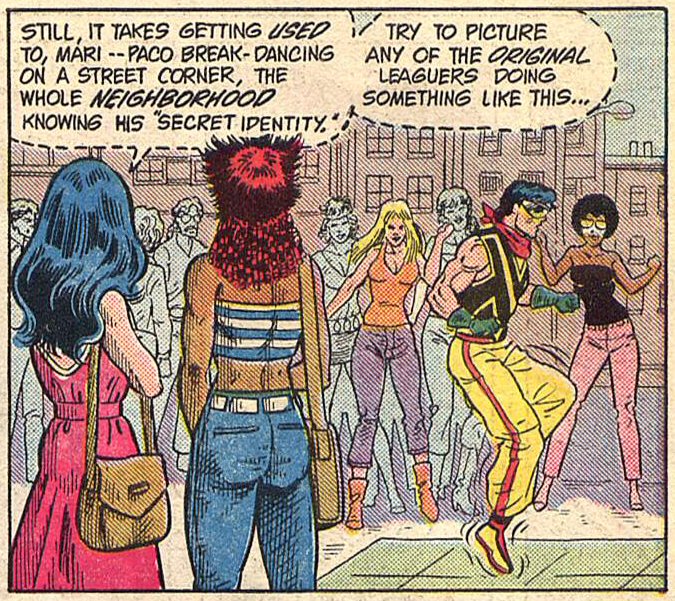 “I dunno Z. I hear Hawkman does a mean applejack, and Superman busted loose with the Kandor Slide at the last JLA/JSA reunion party.”
“Was that when Bruce got all jealous, and started in with the Batusi?”
“You know, we did our best to ignore him whenever he pulled that shit, but it just made him try harder.”



 Posts
Posts


4 comments:
Brilliant post.
I had absolutely no idea about this. Awesome. Awesome. Awesome.
Great blog! Music, humor, and smart writing (with comics! — Who'dda thunk it?). Best line that almost made me choke on my cereal this morning:
“I dunno Z. I hear Hawkman does a mean applejack, and Superman busted loose with the Kandor Slide at the last JLA/JSA reunion party.”
Thanks for the laugh (and the music).
Thanks, folks! Funny that I sat on this topic for months because I thought it would be too esoteric for a wider audience...
Post a Comment