Though I can strongly relate to both Nick Carraway and Paul Pennyfeather, the fictional character I identify the most with is Major Clipton from The Bridge on the River Kwai, gazing down at the panorama of broken bodies and twisted wreckage and despairing at the stupidity and waste of it all: "Madness! Madness!"
An American-educated (tossed around by the media like it's a mark of distinction, though there is no shortage of dumbasses the descriptor applies to) leader of Georgia, a Western-friendly former Soviet republic, tries to mobilize domestic support by appealing to nationalism. He decides to retake a breakaway province with a carefully timed surprise attack that less carefully fails to consider the presence of a couple thousand Russian separatist-friendly "peacekeepers" in said province.
The usual stable of neocon loudmouths, feeling rosy with the glow of Cold War nostalgia, offer their expert predictions about how a massive global military power will be humiliated on the battlefield by 18,000 American-trained troops. Russia is happy to put those theories to the test, as the offensive gives them a plum opportunity to soothe its amputee's itch with a liberal dosage of military force, as well as deliver a message to the West and it's former Soviet proxies about fucking around in Russia's traditional spheres of influence.
The Russians defy the experts' proclamations, put the Georgians to flight, and systematically degrade their military infrastructure over the course of a few days. With his country being hammered by an implacable foe, the Georgian leader makes it his solemn responsibility to act like a true leader to his people in their hour of need....by appearing on American television and making hyperbolic pronouncements and chastising the Western powers for not backing him up and/or shielding him from the consequences of his massive lapse in judgement.
His words are echoed by the usual suspects in the media, who dust off the pre-1989 propaganda lexicons (but not, interestingly enough, their history books) and jettison any pretense of objective journalism to engage in some pre-end-of-history style jingoism, weaving the present state of idiocy into a psuedo-historic tapestry which includes the Russian Civil War, World War II, and the 1968 uprising in Prague. It's astonishingly easy to call for military intervention when you're not the one who will be doing the fighting and dying.
And what of the West? A lot of tough talk masking the fact that there's really fuck all they can do without starting World War III, or worse -- without pissing off a major natural gas supplier. The opportunity the conflict provides to bitch out Putin and Company is welcome, but behind the strong words and messages of moral support for the Georgian government is the uncomfortable and unspoken acknowledgement that no one wants to risk a broken nose because his or her reckless buddy picked a fight with the biggest bully in the bar...especially when you've been telling everyone for years that that the bully is no great shakes.
Russia, on the other hand, has shown a great deal of enthusiasm for twisting the knife as long as it's diplomatically feasible, relishing the opportunity to make its rival global powers twist impotently in the wind.
Ah, what a lovely thing geopolitics is, and if the people -- Georgian and South Ossetian -- whose nationalism was exploited to make this happen are the ones who are suffering most, they can take solace in the knowledge that it has all been done for the highest of ideals.
Icon AD - Fight for Peace (from the Don't Feed Us Shit EP, 1982; collected on Lest We Forget, 2006) - A paradox I can get behind.
Thursday, August 14, 2008
all gonna feel the pain

Wednesday, August 13, 2008
in a boss salad bowl
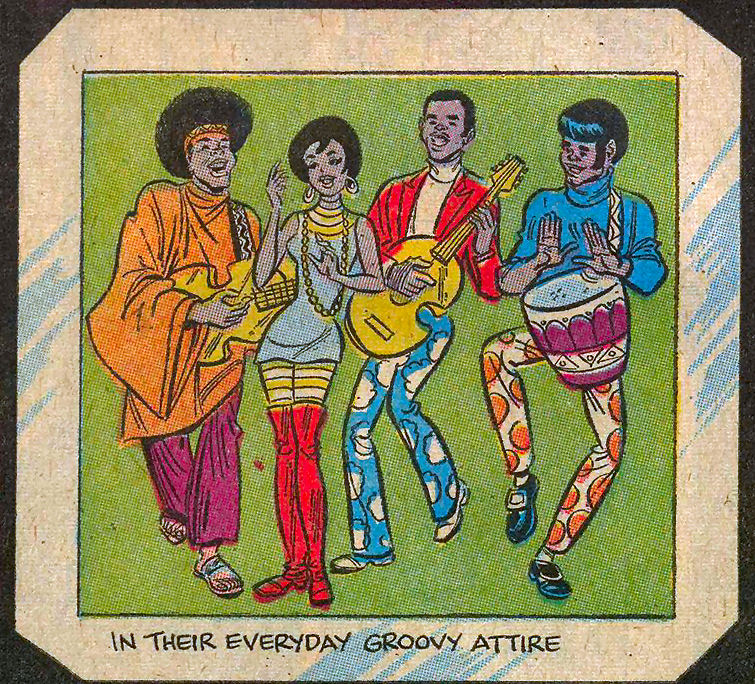
They were the much lauded pioneers of the of the bubble-psych-folk scene, playing to packed houses from coast to coast, and inspiring scores of other bands. They were the one, the only...
The members of the legendary quartet met in San Francisco, where they attended the same junior college, during the Summer of Love. Shortly afterward, they departed Haight-Ashbury for swingin' Toledo, Ohio, claiming that the Glass City was more in tune with their creative vibes.
Sources disagree on whether the band took its name from one of lead singer Zelda's improvised dessert recipes (the official story) or if it referred to a potent form of LSD in vogue with the counterculture crowd at the time. Proponents of the latter theory cite the band's unusual and eclectic lyrics (which featured lines like "We're so hungry we could eat a mountain or a city") as proof of a hallucinogenic influences, though it should also be pointed out that Nelson, who wrote the lion's share of the Mirage's material, had the reading comprehension skills of a ten year old.
In any case, the band quickly made a name for themselves in the local scene, earning them a residency at the Kaleidoscopic Zoo alongside heavy funksters The Soular System and giving birth to a host of similarly-themed acts. For a short time it seemed that Toledo was poised to displace both London and Los Angeles as center of the pop music universe. As big as The Marmalade Mirage was in the Great Lakes region, the release of the the band's debut single in 1969 rocketed them to nationwide fame within days of the record hitting the stands.
"The Marmalade Is Made," written by Nelson and crisply produced by Phil Spector, perfectly captured the band's unique style and electrified a nation with its deeply insighful examination of the social, cultural, and political upheavals of the time.
"It's the song I've always wanted to write, but never could," said Bob Dylan at the time, and John Lennon stated that it inspired him to write "Imagine."
Unfortunately, the runaway success of the single exacerbated the simmering resentments that had arisen between the band members. It also didn't help that they found themselves rushed into recording a full length album by their label, which sought to capitalize on their newfound fame, despite the fact that they had only four songs in their repertoire. The other three members of the Mirage saw this as an opportunity to secure some publishing revenue, which angered Nelson and led to material such as this...
Suffice to say, the album tanked. The bad news that the Mirage had been dropped by their label arrived during the middle of their "Spread the Marmalade" tour, and caused a full-on brawl between the bandmates. Morris had to be stopped from braining Zelda with a microphone stand by Valerie Brown, the bass guitarist of opening act The Pussycats, who broke the guitarist's arm in four places, ending the tour and putting the band on permanent hiatus.
So ended The Marmalade Mirage's brief moment in the sun, reduced from legends to footnotes in the space of a few short months. Zelda moved to an artists' colony in Taos, New Mexico, changed her name to "Galadriel Starshine," and supplements what she earns teaching at a local Montessori school by making high-end dreamcatchers and selling them to celebrity clients such as Dennis Hopper. (She even made an uncredited appearance in Hopper's self-indulgent 1971 flop, The Last Movie.)
Nelson left the music business and entered politics. A protege of Bob Dornan, his effectiveness as representative for California's 46th Congressional District has been slightly diminished after he was videotaped in a motel room with two horses, a donkey, $500,000 in unmarked bills and an empty case for transporting weapons-grade plutonium from Scandia Labs. Calling the allegations and evidence a "left-wing smear job," Nelson has vowed to fight the vote of censure and $50 fine levied on him by the House Ethics Committee.
After Morris's solo career as a singer-songwriter failed to take off, he cycled through a number of engagements with various bands, including a three day stint with Red Rider and a gig filling in for Rick Parfitt for the last few shows of Status Quo's Japanese tour in 2000. His efforts to take a new line-up of The Marmalade Mirage onto the summer reunion concert circuit have been held up by litigation from the band's other original members.
Charlie took the small sum he made from the band and opened an auto repair business in Lorain, Ohio. He never bothered telling his wife or kids about his brief life as a rock star, saying to friends in the scene "that's all behind me now." He served as a proud member of the Rotarians and played a vital role in organizing their annual charity pancake breakfasts. He died in his sleep of a massive heart attack in the winter of 1997.
As I was unable to locate copies of The Marmalade Mirage's actual recordings (which go for nearly a grand on eBay), I've decided to go with a couple of spiritually similar tracks by some of the Mirage's fellow travellers. Diabetics be warned; things are going to get rather syrupy sweet 'round here in a moment...
The Pop Corn Generation - Kitchy Kitchy Koo (from a 1968 single)
The Tingling Mother's Circus - Positively Negative (from The Tingling Mother's Circus, 1968)
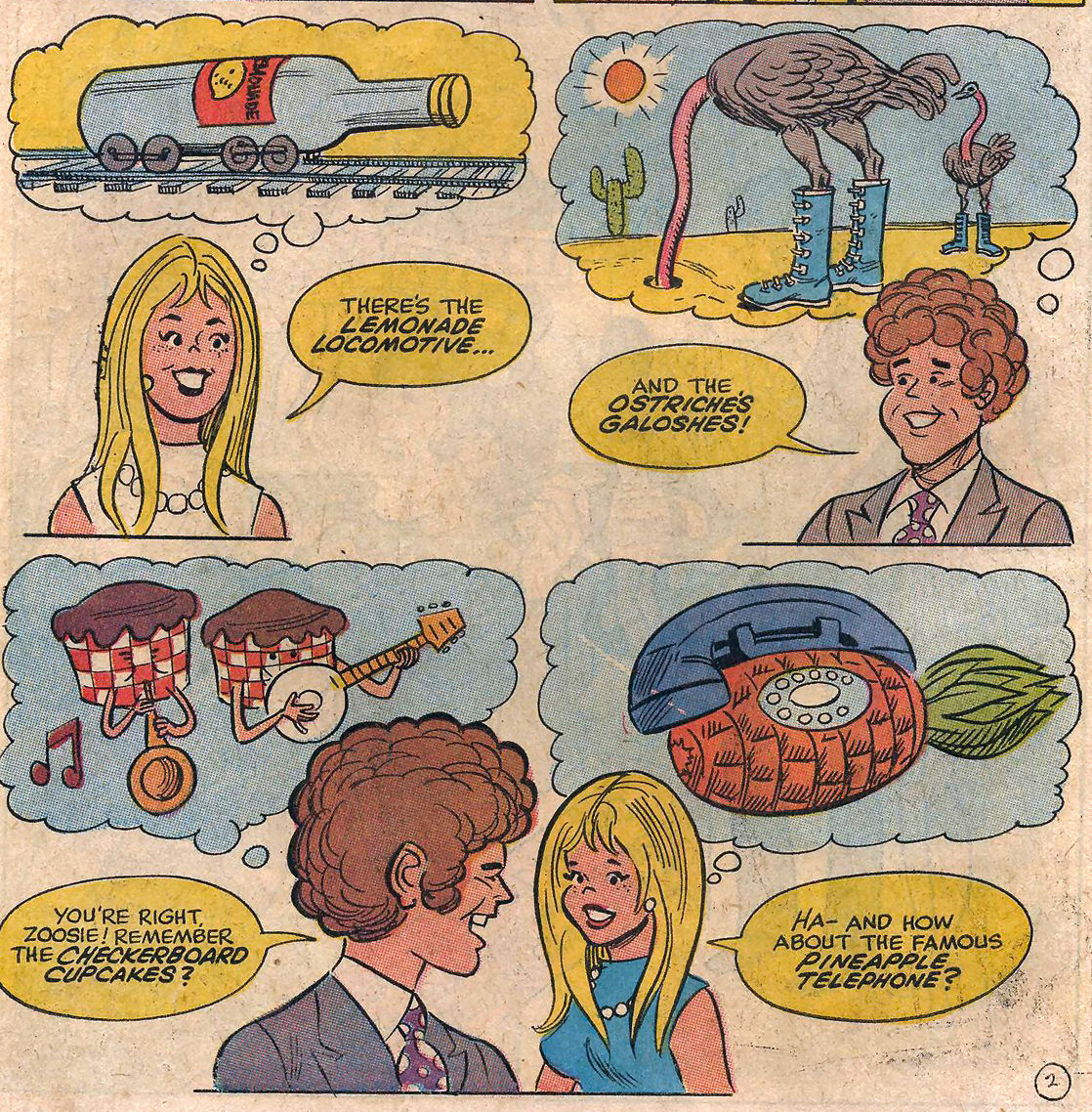
(Blame it all on Harvey Pop Comics #2; November 1969)
Tuesday, August 12, 2008
study in scarlet


Happy birthday, Mr. Sims! I tried to get the Baroness, but she was already booked to appear at a John McCain fundraiser.
808 State - In Yer Face (from Ex:El, 1991) - Techno grooves that hit like unto a thing of iron...or a thrown car battery.
Lalo Schifrin - Main Titles (from the Enter the Dragon OST, 1973) - Facekicking it up old school.
Monday, August 11, 2008
he's out to get before he's got

Isaac Hayes, the legendary Zen master of soul, funk, and cinematic bad-assitude, has passed away at the age of 65. He was the man who made "You shut yo' mouth!" a household expression, and therein lies the problem with eulogizing him.
The popcult resonance of Shaft and the film's Hayes-penned soundtrack has reached Pythoneseque levels of oversaturation in the past three-and-a-half decades. What ought to be appreciated as sublime aesthetic and historical achievements has been reduced to a facile macro employed by mayo-and-white bread fanboys and comedians looking to add a little funky flava into their clumsy attempts at humor. Does anyone want to guess how many times the theme to Shaft or "Chocolate Salty Balls" have been or are going to be spotlighted on the various music blogs in the recent past or immediate future?
Before South Park, before Shaft, before Hot Buttered Soul, Hayes and David Porter teamed up to write some of the finest tracks to come out of the Stax Records stable. Stax soul duo (and perennial AT faves) Sam & Dave were major beneficiaries of their talents, with Hayes and Porter penning such powerhouse hits as "Hold On, I'm Comin'," "I Thank You," and this gem, which has retained its luster even after years of rough handling and rougher reinterpretations...
Sam & Dave - Soul Man (from Soul Men, 1967) - Socially aware Memphis soul, written by masters, sung by the best, backed by both Booker T. & the MG's and the Mar-Keys, and served sizzling hot. If that isn't a recipe for pop music perfection, such a thing simply doesn't exist.
Adios, Truck. When you were hottest, you were the coolest.
When you were baddest, you were the best.
Issac Hayes - Main Title "Truck Turner" (from the Truck Turner OST, 1974) - Whether you're busting heads in a dive bar or busting moves on the dancefloor, you couldn't ask for a finer soundtrack than this.
Sunday, August 10, 2008
my kitten is a dream

After the tragic death of poor Tessie the Tortoise last June, my wife and the kindhearted folks of the Woburn Feral Cat Coalition tracked down and captured the combined litter of Tessa's and her sidekick Pepi's kittens so that they could be socialized and placed in good homes. One of wee kits managed to dodge the feral kitten round-up and started tagging along with Pepi to our house during feeding times. We named the orange and white ball of fuzz "P.J." as in "pajamas," "Pepi Junior," or perhaps as a subconscious homage to the Intrepid Mariner (and Friend to Felines) of the South Coast.
Over the past few weeks, Maura and the folks from the WFCC have been staking out the feral cat feeding sation in our driveway in hopes of trapping the dynamic mother-and-child duo so that Pepi could be spayed and released and little "Peej" could be socialized for adoption before his feral ways could become too ingrained (though I've yet to encounter a feral in our colony that didn't become human-friendly after spending some time around the wife and I. Maura tells me I'm a "cat whisperer," whatever that means).
Pepi, however, has turned out to be as elusive as Robert Denby, and can smell a set-up a mile away even though the irresistable aroma of canned sardines. While Peej has inherited his mom's cunning ways, the WFCC was finally able to trap the little fellow last night while Maura was at a roller derby bout and I was at Target trying to recapture my lost youth via action figures. (What, the Kid Flash shirt didn't already clue you in that I'm a major fucking geek?)
Pepi, alas, still remains at large, and quite possibly pregnant again, but Peej is now chilling out in a little pen we set up for him to feel secure as we try and get him acclimated to humans and indoor life. I've been letting him curl up on my lap while I read so that he can take in his new, strange surroundings from a safe vantage point, and it's been working out pretty well so far (apart from the savaging my right hand took when I tried to clean off some of the dingleberries he brought with him). Our house's resident feline population isn't sure what to make of the new arrival yet, but we're hoping they adjust fairly soon so that we can let Peej roam free and discover the many comforts of housecatdom.
The First Gear - Leave My Kitten Alone (from the Pebbles, Vol. 6: The Roots of Mod LP, 1980) - Here's some fine tooth-and-claw freakbeat from the British Invasion period, possibly featuring (the sources aren't entirely in agreement) the guitar stylings of a young Jimmy Page.
Saturday, August 09, 2008
easier done than said

Spend enough time on the comics internet and you're bound to run across one: a burst of message board bile or an angsty long form blogpost about how some recent event in the comics scene has raped the author's childhood, kicked her dog, or fractured some part of their anatomy, and so now they must holler a pointed "Adieu to comics" from their soapbox. Then, after a hiatus of minutes or even hours, they return to piss and moan about how Jean Grey is depicted in the latest issue of X-Cessive Franchise X-Pansion. Net-based bluster and net-based drama are cheap.
The sad truth is that the habits of ingrained fandom are harder to excise than pancreatic cancer. The attachment to the characters and titles and the serialized nature of the medium make it too easy to stick around for a while and hope things will sort themselves out, especially when a large percentage of the fanbase is caught up in the obsessive collector's mindset and will keep throwing money down a hole for the sake of completeness.
Which is why I was a bit startled to realize that my own sense of fandom has apparently scabbed up and fallen off after three decades. It's not a political statement or an empty gesture of protest...or a gesture of protest of any kind. Nor is it a blanket repudiation of my affection for the medium. I have no plans to unload my collection or quit buying reprint editions or back issues that interest me. I have simply quit caring about the current crop of offerings in the superhero genre and the marketing psychodrama that goes with them.
It was a small epiphany at the end of long, drawn out process, and it happened while I was reading the latest issue of DC's current big event title, Final Crisis. The series and comic itself weren't half bad. It's competently written and illustrated, contains the expected lashings of bombast and melodrama, and is more intelligently constructed than one would expect from an editorially-mandated tentpole title.
As well-crafted as Final Crisis is, it still comes off as an exercise in creative decadence, mired in the poorly focused sense of deja vu that typifies the present-day Marvel and DC Universes. The superhero genre has always been predicated upon finding new routes for the trip to the same old well, but these days it feels different somehow, with familiarity stressed as much as cosmetic differences used to be.
There are exceptions, but for the most part it feels that no one even tries to achieve escape velocity anymore. Instead they settle for a predicable (yet decaying) orbit around childhood nostalgia and creative hero worship that mimics superficial forms but not the underlying substance. The results are essentially licensed fan-fiction, a downward spiral clogged with hobby-horses and trivial obsessions passing for actual storytelling, and kept moving with clumsy grafts taken from the popcult zeitgeist. Why settle for adequate (at best) knock-offs that shamelessly ape the source material when you can just read the original stories?
I fully concede the point that "it's new to you, maybe, but not to a lot of fans," though that same logic, when applied to Gus Van Sant's remake of Psycho over the original film or Oasis's discography over that of The Beatles, comes off as pretty laughable. I've been collecting superhero comics for over three decades now. There have been creative high points and plenty of low ones, and through it all I've managed to stay engaged with the material, with some sense of eager anticipation. Now, at age thirty-six, I feel like I've outgrown the scene.
It's not fan entitlement that moves me, just plain vanilla apathy for current offerings, for the online mind-games between producers and vociferous aggrieved consumers (which is just sort of pathetic), and for the utter foolishness of it all.
Me, curse the darkness? Nah. Better, I think, to curl up on the couch with a tall glass of ice tea and the OMAC omnibus edition and quit pretending I care about Skrulls, demonic annulments, display cases, or other nonsense.
Belle & Sebastian - I'm Waking Up To Us (from a 2001 single, collected on Push Barman to Open Old Wounds, 2005) - It's not you, baby, it's me and you...but mostly you, though.
Friday, August 08, 2008
Friday Night Fights: Calling the Shots
It's pandemonium in the pool hall as Sun Girl (a late 1940's Timely comics heroine and occasional sidekick to the original Human Torch) picks her shots wisely and sinks a couple of hoods like a true shark.

Orbital - The Girl with the Sun in Her Head (from In Sides, 1996) - Get yer ecologically-friendly rave on.
Slowdive - When the Sun Hits (from Souvlaki, 1993) - ...we'll be too busy gazing down at our shoes to notice.
(Come on, let's all celebrate.)
Thursday, August 07, 2008
Schrödinger's landscape

My maternal grandmother grew up in Woburn's west side, three steps from the Burlington line. Her father and grandfather worked at Cummings Farm, long since bulldozed and obliterated to make room for the shopping centers, condo complexes, and office parks that occupy the crowded stretch of Cambridge Road (and it will always be "road," not "street" for me) from Bedford Road to Route 128.
Traces of the Cummings estate still remain, as the bulk of Mrs. Cummings's substantial land holdings were bequeathed to the "children of the City of Boston" in a restrictive trust which eminent domain takings have only taken a small bite out of. Every so often there has been talk by Boston politicians to find a loophole to break the trust and sell the prime real estate, thus securing a huge windfall to fund projects like the Rose Kennedy Greenway or a 1:1 scale replica of the Sphinx -- bearing Tom Menino's face -- to be built on the South Boston waterfront that is Mayor Mushmouth's personal Valley of the Kings.
For now, though, the patches of forest and scrub between the office buildings and used car lots remain overgrown and beyond the reach of deep-pocketed developers. Every time I drive up that way with my grandmother, which is more times than I can count, she delivers the same series of nostalgic rambles about what the area used to be like when she was young.
"We used to race paper boats in that drainage ditch. My uncle drowned in that stream when he was trying out his new galoshes. He was six. I used to babysit for people up this hill. It seemed so steep back then. You could wander wherever, and no one would tell you to get off their land..."
The litany never varied, and became etched in my brother's head and mine through years of repetition. Even when I drive the stretch alone the routine of places and events queues up unbidden, a subconscious mantra and stuff of which family in-jokes are made.
On the way back from our weekly trips to Target, I'll occasionally take a detour through my old North Woburn stomping grounds, though it has become harder and harder to reconcile the visual input with the expectations of decades-old memories. The phantoms retain more substance than the present reality, and I still see the Tomato Hill sandpit or the seasonal marsh/skating pond in the woods in place of the subdivisions that now occupy those spaces.
From my late childhood through my mid-twenties, the pace of development in the area was glacial -- a single-family home here and office building there, but apart from the last lurching encroachments from the local industrial park, there was little in the way of rapid, drastic transformations of the landscape. What did occur was gradual enough to be easily internalized and placed in context. This not only applied to Woburn and its surrounding communities, but to the places in town where I used to spend my time -- Brighton Ave to Kenmore Square, Mass Ave from the MIT Bridge to Porter Square, Cambridgeport to Central Square, Porter Square to Davis.
Then came the real estate boom and tsunami of gentrification that came in wake of rent control being repealed in Cambridge. I also got a car and started driving again, which shifted my axis of operations away from the city and back to the suburbs. I work in Boston, but what I actually see of the city is mostly limited to a stretch of Morrissey Boulevard and the view from I-93. It's no great loss, to tell the truth. In this era of retail chains and global branding, the only difference between city and suburb is that the suburbs have better parking and slightly smaller chance of stepping in a puddle of human urine.
When I do make the rare trip into town, I find a landscape transformed beyond recognition, to the point (as in the time I met up with a friend in Davis Square) where I lose my bearings in places I've walked through dozens of times before. I can deal with the new well enough, but I've yet to encounter an instance of the "new" being an improvement rather than a bland upscale repurposing.
The nature of the changes filters back to me from my wife or from urbanocentric friends. Kenmore Square has been effectively eradicated. Allston has slowly been absorbed into the fiefdoms of Boston University and Harvard. Harvard Square has turned into a strip mall with pretensions of atmosphere and Central Square has gone from the home of radical bookstores and Cheapo Records to hosting The Gap.
There's no real reason to go back anymore, and I prefer to preserve my mental image of the landscape (including the stop sign in Kendall Square my pal Leech walked straight into in a golden moment of unintended slapstick) as it was back in 1994 in a dead/not dead state immune to the quantum flucutations of empirical evidence.
It does make me an unreliable source of driving directions, however.
Duran Duran - Careless Memories (from Duran Duran, 1981) - Infinitely preferable to "Careless Whispers."
Saint Etienne - It's All Gone Horribly Wrong (from The Misadventures of Saint Etienne, 1999) - A Japanese soundtrack album to an English film released only in Spain and which starred an American actress (Parker Posey, as per the Mandatory Posey Appearance Act signed into law by Bill Clinton in 1994).
Svensk - Getting Old (from a 1967 single) - Psychedelic freakbeat is immune to the ravages of time.
Orchestral Manoeuvres in the Dark - Architecture and Morality (from Architecture & Morality, 1981) - Brutalism is maladaptive.
Wednesday, August 06, 2008
waiting for the flash
 Look at that sunavabitch go! Doesn't it just give you a tingly sensation all over, especially in the thyroid and reproductive organs? Since today happens to be the 63rd anniversary of the atomic bombing of Hiroshima, I though it only proper to genuflect a little upon the event and its enduring legacy.
It was the ultimate product of the American "can do" spirit, the fireworks display that kicked off the beginning of the American Century (give or take a half-dozen decades). It showed the world that we had not only developed the means to end human civilization, but were also willing to use it if meant saving "a million lives" (or is that a billion now? Retroactive justifications are not immune to inflationary forces) or intimidating our uncomfortable Soviet allies with a display of overwhelming force upon a civilian target.
That last part worked so well that Joe Stalin's bunch of merry Bolsheviks wasted no time in acquiring some transuranic party poppers of their own, which wagered the future of the human race on a staring contest to end all staring contests. Fun times, indeed, especially for a kid whose global awareness was coming into sharp focus just as Ronnie Reagan decided to escalate the stakes in the name of God, country, and sweetheart defense contracts.
Flipping through issues of Discover and coming across absurdly cheery infographics about the science of the neutron bomb. Sneaking a peek at some of my father's National Guard manuals dealing with post-event assessment and body disposal. Lying awake at night, staring at the ceiling and wondering if I'd be one of the dead or one of the living who envied them. (Knowing what I know now about the target-rich environment of Boston's suburban ring and the power-over-accuracy doctrine of Soviet warhead design, it's clear I'd have been in the dead category, as anything inside I-495 would have become part of Boston Harbor after a full-on nuclear exchange.)
At least it all worked out in the end, right? America won the Cold War, or so I'm told. (How did you spend your promised peace dividend?) History ended, and we now live in a peaceful neo-liberal hegemony overseen by the bestest nation ever. The specter of radioactive annihilation is a thing of the past, a completely justified phase that we've put entirely behind us.
Strongarm sales of ABM equipment designed to provoke the Russians? Official efforts to make the use of tactical nuclear weapons acceptable to the American public? The same conglomerates which are responsible for spiking energy costs attempting to exploit the situation in order to build more nuclear power plants? You must be thinking of some dark alternate universe, friend.
Synch up your Doomsday Clocks, cats and kittens! We're packing a musical MIRV primed and ready to deliver megatons of melodic enjoyment, and you're standing at ground zero! The party doesn't stop until the last payload drops.
Crass - They've Got a Bomb (from The Feeding of the 5000, 1978) - When you've got a massive stockpile of hammers, everything looks like a nail.
Dr. Strangelove & The Fallouts - Love That Bomb (from a 1964 single; collected on Atomic Platters, 2005) - This peppy little track (most likely a Laurie Johnson effort) was released to promote Stanley Kubrick's masterpiece of apocalyptic comedy. Go-go until you're gone-gone.
The Cure - A Strange Day (from Pornography, 1982) - A languid waltz to the shores of the abyss. The view from the edge is fantastic, I'm told.
The Epoxies - We're So Small (from The Epoxies, 2002) - Adieu, my fair synthpunkers! While I'm saddened to see you go, you've left a fine legacy of two outstanding albums, a handful of great b-sides and compilation cuts, and a not-so-good final EP.
Arthur "Big Boy" Crudup - I'm Gonna Dig Myself a Hole (from Gonna Be Some Changes: 1946-54, 2008) - A master bluesman goes underground, twenty-nine years before Paul Weller got the same idea.
Tuesday, August 05, 2008
the bitter redemption of an atypical fat cat
The sedentary comforts of the suburban lifestyle can take their toll on even the most ferocious predatory feline. Sure, it would be great if one could routinely stalk a wild boar and feast upon its steaming carcass, but after a long day of fighting elitist snobs or seeking out the bluebird of happiness, sometimes all one wants to do is order an extra large bacon-fetishists' pizza with a side of cheesy bread and pass out on the couch while watching a Tom Ewell retrospective on TCM.
Even if the nagging feelings that one ought to be taking better care of one's body persist, it's easy enough to resolve such concerns with a weak resolution to do a few ab crunches or take down a bull crocodile...tomorrow...for sure...maybe...once those few remaing Halo 3 achievements have been completed.
The comes a point, however, when the sad truth can no longer be ignored... No need to fret about that spare tire (or matching set of four) or open up an account at The Fat Tiger's Shoppe, my rotund feline friend! Just place a call to the World's Mightiest Personal Trainer! Captain Marvel, the man who once bench-pressed South America, has created an intensive regimen guaranteed to transform oversized Toms into lean, mean, killing machines.
The week long course begins with copious amounts of low-grade amphetamines, purchased in bulk from Marvel's trusted suppliers in the Third World...
...followed by a long, intense session on Cap's personal vibrator.

Next up on the schedule comes the nutritional consultation, with plenty of

...and that approach is carried over into the gym, where what does not kill you could very likely cripple you for life.

And what better way to finish things off than with one of Captain Marvel's patented Bad TouchTM massages?

Once the week is over, the bruises have healed and the bones have knitted together, you'll emerge from the experience feeling, and more importantly, looking like a television star!

(Panels taken from "Mr. Tawny's Diet Dangers" from Captain Marvel Adventures #121; June 1951)
Au Pairs - Diet (from the b-side of the 1980 "It's Obvious" 7"; collected on Stepping out of Line: The Anthology, 2006) - Sparse, unsettling fare, yet incredibly satisfying for those with refined palates.
Southern Death Cult - Fatman (from Southern Death Cult, 1983) - These gothic rockers shed two thirds of their name (and almost the entire original lineup) in order to woo a "Fire Woman."
Monday, August 04, 2008
can't help wondering where I stand

Today is something of a proud day for me, as a routine check of the referral logs has revealed that Armagideon Time is currently the #1 Google result for "how to tell if you are wasting your time on a man."
Eat my dust, Dr. Phil!
I suppose that celestial concordance of specific phrasing and keyword usage obligates me to address the problem in question. With mild power comes mild responsibility, after all. While I do not possess any fancy formal training or a string of high-falutin' degrees, I do have a modicum of empirical wisdom which can be brought to bear upon the matter.
According to the immortal Bard (in Sonnet 116, which was incorporated into our wedding vows):
Love is not loveIt sounds lovely and dreamy, but it's actually a load of horseshit. Horsehit that smells like roses, but horseshit nonetheless. True love is a paradox, a mutagenic constant that threads all manner of alterations and revisions around and about the ever-fixed mark of loyalty and affection.
Which alters when it alteration finds,
Or bends with the remover to remove:
O no! it is an ever-fixed mark
That looks on tempests and is never shaken
In the initial goo-goo eyes phase, one's beloved can do no wrong. In the infatuation hangover phase, the little and not-so-little flaws begin to reveal themselves. Providing that the bonds of devotion weather the stresses of reality, things settle into a pattern of acceptance of your partner's less desirable quirks and the conscious or unconscious attempt to control your own. It's not a perfect process, nor does it immunize you from the occasional dust up, but there is a sense of "US" which overrides two distinct or oppositional "MEs."
Or she realizes that you're never going to quit being a prick and you realize that she's never going to ditch those pain-in-the-ass friends of hers, and you go your separate ways. It can be a tough call to make, but there's no point in prolonging things when it's clear that the two of you will never, ever be on the same page. It's best to face things honestly...and by that I mean "not screwing up a good thing because I'm a restless, self-absorbed shitheel devoid of any sense of honor."
It all comes down to my dad's advice on vice, a maxim that also applies to romance: "If it brings you more pain than pleasure, it's time to give it up."
The Daughters of Eve - Don't Waste My Time (from a 1967 single) - In Narnia, where garages are few and far between, it's called "wardrobe rock."
Grassella Oliphant - Get out of My Life, Woman (from The Grass Is Greener, 1967) - Exorcism through funk. The power of the groove compels you.
Sunday, August 03, 2008
the valet of the infantile
It's been an unusally hectic Sunday and yet another massive thunderstorm is bearing down upon the northwest suburbs of Boston, so I'm going to have to leave you to puzzle out this following sequence from "Poison Ivy," a gag strip from the rich vein of material that is Feature Comics #98, on your own...


The Units - Tight Fit (from Digital Stimulation, 1979) - Together in electric nightmares.
Sounds Incorporated - Sounds Like Movin' (from Rinky Dink, 1965) - I have made it clear in my will that this track will be used as my funeral march. Don't mourn, comrades, shake yer tailfeathers!
Saturday, August 02, 2008
gonna get you from behind
The brief but tempestuous courtship of Doll Man and Madame Diablo, from Feature Comics #98 (May 1946):


Hayseed Dixie - Devil Woman (from Weapons of Grass Destruction, 2007) - Dedicated to the late, great Satana.
Terry and Blue Jeans - Living Doll (from Let's Go! Surfin: Japanese Surf '63-65, 1996) - It seems I've got a (completely unintentional) Cliff Richard-y theme going on today. That's what I call anarchy!
Friday, August 01, 2008
Friday Night Fights: The Girls Are Looking Best
Here's a little extra sand and surf greatness, as the reigning Queen of the Beach, Valerie Brown, schools some fools on the finer points of etiquette...


Donna Loren - Muscle Bustle (from Surf & Drag, Vol. 1, 1989) - The rambunctious side of girl pop, as featured in Muscle Beach Party (1964). Brought to you by the fine taste of Dr. Pepper.
(It's ladies' night and I feel all right.)
I am my ideal

I had a drama professor back in college who was a bit of a rogue, but an outstanding instructor nonetheless. For some reason presumably tied to departmental politics, he was the person who usually got tasked with teaching the foundation courses in Traditions of Western Drama or whatever the prevailing uni-speak is for "reading a shitload of old plays and discussing why they matter."
These were the mandatory courses that every aspiring thespian or playwright had to suffer through before passing onward and upward to the sexier, hands-on parts of the curriculum, but this professor had a knack for making us care about the plays discussed in class. More importantly, instead of conducting the class as a watered-down English Lit course, he approached the material with an accent on technical aspects over critical theory. (Which is how it ought to be for a theater arts class, but in my experience often not the case.)
"Significance" meant less to him than entertainment value, and when the time came to discuss the dreary naturalism of Strindberg, Ibsen, and the like, he came right out and stated "These are historically important plays. They are important works of literature. You should all be familiar with them. That said, I would rather sit through a community theatre Starlight Express than suffer through a Broadway production of Enemy of the People with an all-star cast."
Hardly a divine revelation, but it's one of those moments that has stuck with me over the years even as other, arguably more important parts of my college education have slipped from conscious memory. The idea that a tenured professor of literature with an impressive resume could step outside the ivory tower and make case for entertainment value in and of itself made me realize that I wasn't just gaming the system and wasting my time at college, humoring the unfortunately high number of insular or clueless instructors that viewed appreciation as a gnostic process, removed from the vulgarity of the masses. (Seriously. I had one professor who was shocked, shocked, to discover that fans of romance novels were not a monolithic block of uneducated bon-bon munchers.)
Or I should have taken it as a clear warning that my lateral thinking processes and poor sense of self-discipline were fundamentally at odds with formal academia. Honestly, if I had to do it all over again, I'd have gone to trade school to be an auto mechanic and kept with the autodidactic route when it came to the the study of humanities.
In any case, the complicated relationship between entertainment and art is something I've addressed quite a few times already on Armagideon Time, usually in reference to the medium of comics or music. Despite recurring assertions to the contrary, quality is a relative concept when it comes to something a personal as "art," and while it is possible to establish a hierarchy of aesthetic value on a macro level, the boundaries tend to blur with closer examination. As always, keeping a sense of perspective is the best course of action, and that's something which is most easily achieved by observing the widest possible vista instead of limiting one's experiences to a single strata, be it lofty peaks of "high art" or the vulgar sumps of disposable entertainment.
Which brings us to AIP's series of Beach Party movies, director William (the real-life Mr. Samantha the Witch) Asher's sybaritic counterpart to Roger Corman's stygian Poe cycle of technicolor exploitation fare -- the Eros and Thanatos of early 1960's drive-in theaters.
Pal Dorian has dedicated this week to the antics of Frankie, Dee Dee and the gang, and his analysis of the series hits pretty much covers all the salient points I could possibly make about their enduring appeal.
The jokes are pure corn, the surfing scenes are almost avant-garde in their rear-projected fakery, the original musical numbers are embarrassingly dire, and the hokey bacchanalia of the privileged white "teenage" characters occurs in a world completely isolated from what was going down in America's inner cities or over in Southeast Asia at the time.
As terrible and cheapjack as the Beach Party films are, though, I can't help enjoying them nonetheless, and no summer vacation would be complete without a Sunday afternoon viewing of at least one the movies. (This year it was Muscle Beach Party and Beach Blanket Bingo.) Chalk it up to nostalgia -- nostalgia for a childhood when the films were staples of weekend afternoon UHF programming, for the lame-but-quaint tropes of vintage sitcom-style humor, and most importantly for the reassuring presence of various guest-stars drawn from the stable of character actors (Paul Lynde, Mickey Rooney, Vincent Price, Peter Lorre, et cetera) familiar to every heavy TV-viewing kid of my generation.
I wouldn't make a case that the films occupy a loftier cinematic position than, say, The Godfather, but I do know what I'd rather sit down to watch on a lazy summer weekend. Coppola's epic may masterfully dissect the nature of the American capitalism, but it does it feature lip-synched performances of either of these musical gems?
Stevie Wonder - Happy Street (from The Complete Motown Singles, Vol. 4, 2006) - A swingin' soul celebration, as featured in Muscle Beach Party (1964).
The Kingsmen - Give Her Lovin' (from The Kingsmen, Vol. 2, 1964) - Ginchy garage rock, as featured in How to Stuff a Wild Bikini (1965).
Thursday, July 31, 2008
oh sexy voice
 "It's like they're whispering to you, and you alone," says the wife about what she calls the Sexy Voice Men, an exclusive group of vocalists capable of seducing with a song.
I, on the other hand, have been stuck with a not-quite-as-sexy voice -- unless one's turn-ons include a nasally alto overlaid with an occasionally impenetrable Boston accent.
Alex Kapranos: Franz Ferdinand - The Dark of the Matinée (from Franz Ferdinand, 2004) - Yesterday's darlings, long on splash and short on ripples as the critics' Eye of Sauron moved onto a succession of other, fresher subjects to overpraise and subequently abandon.
There's supposedly a new album on the horizon, though I have to wonder if the ship hasn't already sailed for FF and the cluster of other acts tagged with the overreaching "postpunk revival" label. I suppose the label did fit, providing you define postpunk as "overproduced Joy Division knockoffs, countless riffs on XTC's back catalogue, and the post-Japanese Whispers version of The Cure." There were some jewels, such as the above track, amidst the dross of wishfully derivative marketing, though.
Casey Spooner: Fischerspooner - Sweetness (from #1, 2001) - Elaborate prank or work of genius? I'm still unsure what to make of the provocative synthesized pageant that was #1, which was equal parts Marcel Duchamp and Marc Almond. I do know I was resoundly disappointed by the band's 2005 follow up album which jettisoned the confrontational quirkiness in favor of a more sedate dance pop template.
Jarvis Cocker: Lush - Ciao! (from Lovelife, 1996) - Goodbye, dreamy shoegaze! Hello, lackluster Britpop! To prove their trendhopping bonafides the band even enlisted the velvet-voiced Prince of the Common People to join vocalist Miki Berenyi on this iteration of the tired-and-true "He said/she said" formula. Works for me.
Wednesday, July 30, 2008
Sacred Cow Tipping #1: Take a load off, Spidey
 "The Final Chapter!" from Amazing Spider-Man #33 (February 1966) is the appropriately-named conclusion to a three-part story arc that served as a pivotal moment in the title character's Lee-and-Ditko-produced Bildungsroman. In order to save his beloved Aunt May from a severe recurrence of chronic Pestilentia Melodramatica, Peter Parker suits up as Spider-Man and goes toe to toe with Doctor Octopus in order to retrieve the serum that could cure his ailing aunt. Things take a turn for the crappy, however, when Doc Ock's undersea lair collapses, trapping poor Spidey beneath a couple dozen tons of junked machinery with the vital cure just out of the hard-luck hero's reach -- which is where "The Final Chapter!" begins.
Spidey's struggles in the story to find the inner strength to free himself and save Aunt May is considered, rightly, to be one of the finest moments in Marvel's Silver Age output, even by folks who usually cast a jaundiced eye at the superheroic material. In a genre predicated on the illusion of change, the story offers the genuine article -- Peter's transformation from a well-intentioned teen playing at being a hero into an adult who understands and accepts what the job actually entails. It is a work of importance, albeit parochial to the genre, certainly deserving its designation as a "classic" story, and yet....
...once you get past the mythic aura of reverence, what it comes down to is a bunch of pages of Spidey pontificating in eight shades of purple from his pulpit in the rubble, padding out the scene until its foregone conclusion.
Here's the Andrew-edited abridged version:


SPOILER ALERT: He eventually summons the inner strength to free himself, which is why the title of the series didn't change to the Amazing Spider-Man's Decomposing Corpse with issue #34. (Fandom would have to wait four decades and for a hot trend needing flogging in order to witness how that premise would play out.)
Interestingly enough, while the predictably pedestrian (or as the high-brows are fond of saying "like something from a comic book") catalyst for the character's evolution gets the lion's share of attention, the effects of the transfomation don't actually manifest until the end of the story, when a bruised Peter blows off semi-girlfriend Betty Brant's concerns about his safety then proceeds to stand up to J. Jonah Jameson's bullying. These inversions of the standard Spider-Man tropes are the true crucial moments of the story arc, and their effectiveness surpasses the "I can't lift the rubble! I must lift the rubble! I can't lift the rubble! I'll lift the rubble!" hijinx it took to get there.
Tuesday, July 29, 2008
hungry so angry
Yesterday a friend asked me "Why'd you pick 'Armagideon Time' for your blog's name?" When I decided to create whatever-the-heck-this-site-is back in the spring of 2006, there was a short list of potential names I considered using. All but one, "The Land of Clear Blue Radio" (after The Soviettes' song), were Clash-related, in honor of the high regard in which I hold for the "only band that mattered."
"Capitol Radio One," "Gates of the West," "The Right Profile" were all worthy contenders, but none felt or sounded as perfect as "Armagideon Time." Apart from being the title of an outstanding track (whether one is referring to the Willie Williams or Clash version), it also dovetailed nicely with my own personal infatuation with things apocalyptic and foreboding. It's not a religious thing with me, but a legacy of childhood anxieties that I have carried with me into adulthood.
From the depressing extrapolations of 1970's sci-fi to the nuclear dread of the Reagan Era, my formative years were spend bathing in a popcultural spring of visions of the End Times, presented as an inevitable occurrence though the actual vector of Armageddon (nuclear war, ecological collapse, revolt by intelligent apes) varied from source to source. There is something I find fascinating in apocalyptic flights of fancy -- they way they speak to the collective anxieties of an given era/culture as well as the vicarious thrill of watching the human species choke on its own excessive folly or come up short against uncaring entropy.
If there's a sincere cautionary message, it's usually so overdressed in sensationalism or hyperbole that it devolves into unintentional parody, a trite moral to justify the big draw of the spectacle itself. Or else it merely emphasizes a small-but-dramatic part of the big picture over the little details, the ones with real-life significance.
I recently came away from a trip to the local comics and used book store with a plastic grocery bag full of old paperback sci-fi and horror novels. My haul, which set me back all of twelve dollars, was evenly split between works of relative quality by the likes of Huxley and Spinrad and number of volumes of "catastrophe porn." I use the term "porn" rather loosely (though not inaccurately, as we shall see) to differentiate these dubiously prophetic potboilers from the blanket term of "disaster fiction" coined and thoughfully analyzed by Mike Davis in The Ecology of Fear.
Unlike Paul Auster's In the Country of Last Things or Cormac McCarthy's The Road, the apocalyptic elements in catastrophe porn are not integrated backdrops for an actual narrative, but in fact supercede whatever thin narrative might exist. Characterization and plot serve as skeletal frameworks from which to hang the series of sensational vignettes which are the real selling point of such works. It's not about whether or not Chuck Heston will reconcile with Eva Gardner -- it's about watching L.A. collapse into rubble and anarchy.
Here's a excerpt from the back cover of the 1981 Ace Charter edition of Graham Masterton's Famine, an excellent example of the subgenre which also happeded to be the first of the stack I pulled out to read:
Hilarious, offensive, and informative!
There is something of a plot in Famine. A big city actuary turned Kansas farmer and his Manhattan-loving wife find their existence turned upside down by a multi-pronged assault on America's food supply. While corrupt and/or politicians attempt to exploit or acknowledge the situation, the country falls into a state of complete anarchy. The mystery of who caused the crisis doesn't so much unfold as pop out like a built-in turkey thermometer. (Is it the Soviets? Who could it be but the Soviets? Maybe it isn't the Soviets? But who, if not the Soviets? Yep, it's the Soviets. Oh, well.)
Really, though, it's a lot of wheel-spinning in anticipation of the juicy parts, little lurid nuggets describing all manner of horrors unleashed by the disaster.
In Muskogee, Oklahoma, twenty men and one woman tried to break into a supermarket and steal boxes of canned meat, vegetables, and fruit. They were almost through loading when they were surprised by a National Guard patrol who machine-gunned all of them with warning. Their bodies were littered across the parking lot, and a reporter for the Herald-Bulletin of Tulsa said, "There was so much blood it was gurgling down the storm drains like crimson bathwater."It's a veritable pagent of graphically-described murders, looting, riots, and a disturbing amount of rape, including one scene that surpasses anything from American Psycho for sheer "what the fuck is wrong with this author?" vileness). Ample lashings of sex and ultra-violence are the order of the day, resulting in something akin to a non-racist* version of Camp of the Saints or The Turner Diaries, apolitical save for the pithy observation that the American people overconsume, are overentitled, and are prone to violence.
Gee, I never noticed.
Masterton writes in a style reminiscent of James Herbert's, which is essentially a stripped down version of Stephen King's style with the sensationalism cranked to the highest setting. It certainly fits the level of the material, though lines such as this one...
"You've been growing wheat for nearly forty years, and all I've been doing is sitting on my butt in a stuffy New York office, telling little old ladies how to salt away their surplus dollars for a rainy day."...and not recall the painful days of one's freshman creative writing class.
Famine is utter crap, but utter crap that greasily fulfills its purpose as a disposable, sleazy read which capitalizes on the fears of privation felt by a society that had recently experienced several shortages of essential goods. Yeah, I know, it seems so quaint and silly from a present-day perspective.
Now if you'll excuse me, I need to take out a second mortgage so I can gas up the car and buy a loaf of bread.
Willie Williams - Armagideon Time (from Armagideon Time, 1979) - Back to the roots.
Eddie Albert & Eva Gabor - Theme from Green Acres (from Television's Greatest Hits, Vol. 1, 1990) - Ever want to see an episode of Green Acres where Oliver was seduced by a busty double agent working to cultivate a corrupt senator as the puppet leader of a future Soviet-occupied and famine-ravaged America? If so, then I have book suggestion for you.
*The book does mention that black looters were more violent than white ones in the initial wave of food riots, but by the end everyone has sunk to the same level of lawless behavior, though white L.A. residents are singled out as being especially monstrous. It's not hard to deduce the book's target audience.
Monday, July 28, 2008
when you put it that way
Scholastic's Dynamite used to run a regular feature titled "Super-Heroes Confidential," much adored by my younger self yet completely forgotten about until I flipped through the recently purchased stack of mid-1970's issues of the defunct kiddie magazine.
It was a pretty nifty (and corporately ecumenical) method of genre evangelism from a time when kids were still the primary target audience for superhero comics. Each installment spotlighted a specific superhero -- mostly Marvel and DC characters, though I vaguely remember some representatives of the King Features comic strip stable getting face time -- with a smartly recolored reprint of the character's origin story followed with a single page FAQ covering other details and semi-pertinent information.
In a time before The Official Handbook of the Marvel Universe or Who's Who in the DCU and the ready availability of comprehensive reprint collections, it offered the tykes a handy little infodump (and an opportunity to read otherwise unavailable material) to kindle the flames of nacent fandom...even if for only a short while.
The FAQ sections are especially priceless, as they attempted to distill months and years of often slapdash sequential storytelling into a couple of sentences of kid-friendly plain text. It may have escaped my notice at the time, but these nuggets of continuity-laden (and now, thanks to the endless circular grind of the medium, mostly out-of-date) trivia highlight the stupidity and absurdity of the genre in a manner that surpasses works such as Watchmen or Marshal Law.
For instance, check out this explanation of Captain America's romantic take on "family values," from a 1974 issue of Dynamite:
Jeepers, Cap, she's only (Agent) 13!
Roger McGuinn - American Girl (from Thunderbyrd, 1977) - I have nothing but the utmost respect for Roger McGuinn, both for his role in The Byrds and his subsequent solo career, but this baffling take on a Tom Petty classic is just wrong.....though not nearly as wrong as fucking the sexy younger sister of your middle-aged former flame.
Dead or Alive - Brand New Lover (from Rip It Up, 1987) - Don't look at me like that. Claim as much indie/punk rock cred as you want; we all have dance pop skeletons in our musical closets.
Sunday, July 27, 2008
Vacation 2008: Epilogue - Just a matter of time

...and just like that, it's all over.
It's not like I didn't accomplish anything during this past week or so. I built a compost bin. I finally managed to get the patio table out of the basement and onto the patio. I bought a ton of retro-junk that will almost certainly figure into upcoming posts. I got to enjoy New England's first monsoon season (not that Al Gore is right about global warming or anything) from the comfort and safety of my home in the Woburn Highlands.
As bad as playing catch-up as work will be, it's nothing I haven't handled a dozen times before, yet I still can't shake the feeling that my stay of execution is about to elapse. Does the condemned have any last requests? Yes, dispense with the last meal and bring me some fine, fine L.A. power pop to comfort me in my indolence's dying hours...
The Plimsouls - Zero Hour (from The Plimsouls, 1981)
Saturday, July 26, 2008
Vacation 2008: Day 8 - Cruising attitude

The Embarrassment - Sex Drive (from a 1980 single; collected on Heyday: 1979-1983, 1995) - Is it still an "obscurity" if it has already been posted by every punk rock blog on the internet? No matter, this cut by Witchita's finest is always worth a listen or three.
The Lookalikes - Can I Take You Home Tonight? (from a 1980 single) - In which some Irish powerpoppers try to get lucky. (It's a far classier approach than my high school friends used to use, but the Zubaz/white leather jacket/snakeskin boots/gold chains/Drakkar Noir ensemble isn't exactly a high bar to surpass.)
Friday, July 25, 2008
Vacation 2008: Day 7 - A long way from Denver
Nothing too elaborate today, just a pair of curious celebrity homages to the bespectacled golden-haired prince of the 1970's easy listening pantheon, courtesy of The Muppet Show...
Jim Nabors - Thank God I'm a Country Boy (from Episode #1.6; June 8, 1976) - Well, golleeeee! Sadly, Frank Sutton's heartfelt rendition of "Annie's Song" has been lost to the sands of time.
Cheryl Ladd - Sunshine on My Shoulders (from Episode #3.24; May 10, 1978) - The voice of an Angel (and a one-time Pussycat, too).
Thursday, July 24, 2008
Vacation 2008: Day 6 - Where were you in '92?

Some friends and I were recently discussing movies from the 1990's (hey, it happens), and someone brought up Singles, Cameron Crowe's 1992 Gen X update of the 1980's teen flick formula. "Singles is okay as a film, but as a socio-historical document it is magnificent," was my assessment, which led to the usual talk about the film's popularizing of Seattle's grunge scene.
That's true, I suppose, though I don't think it's as cut-and-dried as some Monday morning popcult quarterbacks would have you think. It's one of those "chicken or the egg" scenarios, capitalizing on emerging hot trend even as it -- or, more accurately, the film's soundtrack -- heightened the masses' interest in the same. (The film spent some time in release date limbo before the studio execs realized that there was some marketing synergy to be had with the buzz coming from the PacNorWest.) However, it wasn't Singles' relationship to the flannelmania scene that I was referring to when I gave it props as a historical document, but rather the how the movie managed to perfectly capture the spirit of the moment.
I was twenty in 1992, drifting listlessly through my sophomore year in college...or maybe my "second" freshman year....the traditional definitions don't really work with the whole seven year plan thing. Every generation feels that they occupy a place of singual importance on history's stage, but at the time it really felt as if we were on the edge of something huge and important, a fundamental break with our Boomer parents' vision of society. The fourth floor of Wheatley Hall, home to UMass Boston's student clubs and organizations, was abuzz with such sentiments, but even outside that rarfied atmosphere, the world at large seemed poised for a tectonic shift.
ACT UP, Queer Nation, PETA, Irish Northern Aid, third wave feminism, Sister Soulja, Body Count, the L.A. riots, the end of the Cold War, next-gen environmentalism, the lingering effects of the late 1980's recession, the 1992 presidental election -- a multitude of forces were in motion and the beach was just a few small paving stones away. Out with twelve years of Reaganism and Reaganism Lite and in with the new...or at least the different.
Then the DotCom boom hit, and my generational peers swapped out nose rings and Doc Martens for Gap clothes and 401k plans and fiscal conservatism and condo associations. The Soundgarden albums kept their places on the CD rack, but Dave Matthews and the Goo Goo Dolls got the heavy rotation. I don't fault them (okay, I do, but I'm trying to be charitable) but how did "I won't be like my parents" turn into "I will be exactly like my parents, only with an affected sense of irony and a thin veneer of hipness"?
Then, to add insult to injury, the Republican Revolution swept in to mock the corpse of ideals abandoned.
Watching Singles isn't just an exercise in undergrad nostalgia for me, it's a painful, poignant reminder of a world that was and could have been, had it not been tripped up by its own shallowness and solipsistic apathy. This is why I can't help but discern a familiar tune whenever I come across Gen Y or Gen Z or Gen Whatever-the-fuck-is-the-sexy-letter-demographic-now diatribes about being the "voice of change" and the fulcrum on which a new world will slide into place.
Youthful sincerity is by definition an ephemeral phenomenon, and the counter-revolution is just a glib joke and revenue-sharing plan away.
The musical annotations for this post probably should have run toward the grunge end of the spectrum, but my dislike of the genre has only grown with the passing of years. I instead offer this representative pair of tracks from my circa 1992 playlist...because some things -- such as superlative Welsh punk rock and radical Marxist postpunk -- never go out of style.
The Partisans - The Money Rolls In (from The Time Was Right, 1984)
Gang of Four - At Home He's a Tourist (from Entertainment! 1980)


 Posts
Posts